Forward

Wednesday, October 15, 2014

DR. VON LYRIC: The Camellias Never Fade

When Sir Frederick Ashton's one-act ballet (set to the D minor piano sonata by Franz Liszt) Marguerite and Armand was premiered in 1963, it was the center of intense interest, not only from the ballet world, but also from the somewhat prurient curiosities of a celebrity culture. Could the plot of the ballet reflect the off-stage realities of the situation between Rudolf Nureyev and Dame Margot Fonteyn?..."Hot young (25) stud melts the older (44) frigid snow queen prima ballerina," etc., etc. By all accounts Fonteyn gave a performance of perhaps unaccustomed emotional ardor equaled in intensity by Nureyev's almost blatant sexuality, and the piece became a potent signature of their partnership. It was not performed for awhile after her death in 1991 (Nureyev died in 1993), but it has been recently revived with other dancers.


The familiar story was also translated into dance by John Neumeier for the Stuttgart Ballet in 1978 as a full-length ballet using the music of Chopin. A significant version was produced for the Paris Opera Ballet with compelling performances by Agnès Letestu and Stéphane Bullion. The piece is not without its elements of kitsch and overblown and over-articulated emotion, but the love duets do work up considerable intensity and sexiness.


And then there is Camille and Greta Garbo. If somehow you have never seen it, seek it out. Robert Taylor takes some adjusting to, but Garbo is sublime.


Here is a bit of Sarah Bernhardt in the death scene (at 42 seconds on in the film clip).


Dimly lit, distant, often out of focus, questionable sound, but a least a rare peek at Callas on stage as Violetta (with Alfredo Kraus), Lisbon 1958.


And at last, a look at La Traviata in its place in the seemingly inevitable final repository and apotheosis of culture in this country - the ice show!


Friday, October 10, 2014

LA TRAVIATA—BACKGROUND STORY

By Magda Romanska, Ph.D., BLO Dramaturg


La Traviata, a melodrama in three acts, was set to a libretto by Verdi’s longtime collaborator Francesco Maria Piave and is based on Alexandre Dumas fils’ play, La Dame aux Camélias (The Lady of the Camellias). The play itself was adapted from Dumas’ novel of the same title, which was published in the summer of 1848 by A. Cadot of Paris, when Verdi was in the city. The play was initially scheduled to open at the Théâtre Historique, where Dumas père worked as director, but the theatre experienced financial problems and eventually closed for good. In 1851, the second edition of Dumas’ novel was published, with an introduction by Jules Janin which revealed the true identity of the mysterious Lady of the Camellias. In the meantime, as the sensational story grew in popularity, the play was vetoed by the censors. Eventually, after the coup d’état, the production was given permission and the play premiered at the Théâtre du Vaudeville in Paris on February 2, 1852. It was an instant success, enjoying 100 consecutive performances. In May of 1852, it was performed in French at the Teatro Re in Milan, and the Italian version of the play was published in Milan shortly after. In 1853, while La Traviata was in rehearsals at La Fenice in Venice, Dumas’ The Lady of the Camellias was playing at the Teatro Apollo in the same city. When La Traviata finally opened, the audience was already pretty familiar with the story, a fact widely noted by the local newspapers:

Because of the great fuss made by the Paris newspapers about it, and the countless performances it enjoyed at the Apollo, we believe that our readers will not only be familiar with the subject of the opera, but will know the play word by word. The subject is none other than La Dame aux Camélias by Dumas fils, adapted a little clumsily—as is customary with operatic plots—and transported back to the time of the great Louis in order to create an excuse for a little more grandeur and lustre in the stage decorations. (quoted in Sala 60–61)

Out of all of Dumas’ stories, the tale of the “Lady of the Camellias,” who eventually came to be known as Camille, turned out to be his most popular and most enduring, with 16 versions of the story staged on Broadway alone, and nearly 30 different film adaptations, including the two most well-known versions: the 1936 Camille, directed by George Cukor and starring Greta Garbo as the title character, and the 2001 Moulin Rouge!, directed by Baz Luhrmann and starring Nicole Kidman. Even Erich Segal’s 1970s novel, Love Story (and the iconic movie based on the novel) is said to be modeled on Dumas’ story, with the class difference between the two lovers and the sickness and death of the female protagonist framing the melodramatic plot.


Dumas’ heroine, Marguerite Gautier, was actually based on the real-life Marie Duplessis (1824–47), his lover and a popular French courtesan and salon hostess. A known mistress to a number of prominent men of her era, Marie died tragically of tuberculosis at the age of 23, leaving behind one of the most enticing myths of her epoch. The story goes that although she was born a peasant, Duplessis managed to climb the ladder of Parisian society from laundry girl to one of Paris’ most celebrated courtesans thanks to her wits and striking, ethereal beauty. She was tall and pale with dark hair and “lips redder than cherries”- Dumas wrote, she looked “like a little figurine made of Dresden china” (quoted in Kavanagh). She was reportedly smart, pragmatic, and widely admired, and her salons were attended by the likes of Franz Liszt, Honoré de Balzac, Alfred de Musset, and Théophile Gautier. While conducting an affair with young Dumas, Marie was supported by an octogenarian, Count Stackelberg, and pretended to be his daughter. Dumas is said to have been forced to sneak around, hiding from Stackelberg, as he himself was too young to be able to support Marie and her extravagant household. It is unclear whether Dumas based the fictional character of Marie’s lover, Armand Duval, on himself or on Count Edouard de Perregaux, who was so in love with her that, in 1846, he married her against the wishes of his family. At the end, as she was dying of tuberculosis, Marie – abandoned by her lovers and cared for only by her faithful maid Clothilde – died while a horde of creditors were knocking on her door. When Marie died, her possessions were auctioned off to pay her debts, an event which the journalists of the times treated at length, one of them writing sensationally: “All of Paris was crowding to the sale of a lady of the demi-monde, Marie Duplessis, who had led the most brilliant and abandoned of lives, and left behind her the most exquisite furniture, and the most voluptuous and sumptuous bijouterie” (Sutherland 1893: 131). On March 6, 1847, L’Illustration featured an elaborate description of the sold objects “that awoke curiosity, if not the greed, of the holiest and chastest of women” (Sala 63).

The legend goes that Marie loved camellias. In 1886, Henry Sutherland Edwards wrote: “Little did the Jesuit Camelli, when he brought from Japan the flower which was to bear a name derived from his own; little did he think of what class of women this flower—Camellia Parisiana—would one day become the recognized symbol. It is without fragrance; for which reason, in its outward and inward significance, it was habitually worn by the fair one without reputation to whom the name of La Dame aux Camélias was so appropriately given” (212). Although she foremost loved white camellias, Marie is said to have worn a red one during her time of the month to indicate to her lovers that she was unavailable. Thanks to all the stories circulating about Marie and her flowers, the camellia gained a special mystique. Elegant, simple, and enigmatic, in the early 20th century, the camellia was adopted by Coco Chanel as a symbol of the fashion house’s haute couture. Since then, the flower has become a staple of wardrobes around the world.

Dumas’ novel was published shortly after Marie’s death, and the play premiered four years later, on the wave of the increasingly titillating story. Verdi and Piave adapted Dumas’ play in record time while Verdi was still working on Il Trovatore. Although he would typically take four months to compose an opera, Verdi took just four weeks to compose La Traviata. The original working title for the opera was Amore e Morte (Love and Death), but it was changed at the request of censors. Verdi was very much taken with the tale, considering it “a subject of the times,” as he wrote to his friend Cesare De Sanctis (Fisher 2007: 17). La Traviata premiered in Venice, at Teatro La Fenice, on March 6, 1853, with a cast that included Fanny Salvini Donatelli (Violetta), Ludovico Graziani (Alfredo), and Felise Varesi (Giorgio Germont). The first staging received mixed reviews, prompting Verdi to write to his friend Emanuelle Muzio, "La Traviata last night a failure. Was the fault mine or the singers? Time will tell." Time did tell. The second staging, on May 6 of the following year, with a different cast and revised score, was an instant success.

First image: Marie Duplessis, painted by Édouard Viénot. Rue des Archives/The Granger Collection. Second image: Watercolor of Marie Duplessis at the theatre, by Camille Roqueplan. Third image: Poster by Alfons Mucha (1896) for the production of La Dame aux Camélias with Sarah Bernhardt.

Read more:

Cross, Milton. Complete Stories of the Great Operas. 1st ed. Garden City, NY: Doubleday, 1947. Print.

Dumas, Alexandre. Camille: or, The Fate of a Coquette. Philadelphia: T. B. Peterson & Brothers, 1880. Print.

Edwards, Henry Sutherland. Famous First Representations. London: Chapman and Hall, 1886. Print.

Fisher, Burton D. Verdi's la Traviata: Opera Classics Library Series. Opera Journeys Publishing, 2007. Print and on-line.

Martin, George Whitney. Verdi: His Music, Life and Times. New York: Dodd, Mead, 1963. Print.

Old and New Paris: Its History, Its People, and Its Places, Volumes 1-2. London: Cassel and Company Limited, 1893. Print.

Parker, Roger. The New Grove Guide to Verdi and His Operas. Oxford; New York: Oxford University Press, 2007. Print.

Remarks on the Morality of Dramatic Compositions, with Particular Reference to “La Traviata,” etc. London: J. Chapman, 1856. Print.

Roberts, Nickie. Whores in History: Prostitution in Western Society. London: HarperCollins, 1993. Print.

Sala, Emilio. The Sounds of Paris in Verdi’s “La Traviata.”  Trans. Delia Casadei. New York: Cambridge University Press, 2013. Print.

Thursday, October 9, 2014

DR. VON LYRIC's Clouded Crystal Ball Department

As we get ready for tomorrow's Opening Night, take a look back in time at a review of La Traviata's Boston premiere. Who would have predicted it would become one of the world's most popular operas?

The recent compositions of Mr. Verdi afford a remarkable example of what might be called the "Art of Sinking in Music." Each of the last four or five operas he has given to the world has been considered inferior to that immediately preceding it, and it now becomes a matter for anxious consideration what we are to expect in his next lyrical production, should he continue in this manner. It can hardly be anything better than a series of brilliant and somewhat noisy quadrilles, polkas, and waltzes, for ponderous orchestra, with weak vocal accompaniments. Indeed, while listening to the Traviata one's first thought is - what a beautiful writer of quadrilles was lost to the world when Mr. Verdi devoted himself to the manufacture of operas. That the Traviata is more deficient in science and imagination than anything he has previously written cannot be denied.

The Courier. June 1857.

LA TRAVIATA — BEAUTIFUL DEATH

by Magda Romanska, Ph.D., BLO Dramaturg


“The death of a beautiful woman is, unquestionably, the most poetical topic in the world.”

—Edgar Allan Poe, “Philosophy of Composition,” 
originally appeared in Graham’s Magazine, published in Philadelphia, in April 1846

The 19th-century affair with death is no great news to anyone even remotely familiar with its art or literature. It was a period of morbid aesthetics and a peculiar and apparently inexplicable fascination with deadly eroticism. The poetic and artistic imagination of the time began conceiving of the erotic as invariably “touched by death,” and of death as invariably touched by the erotic. In this climate, the beautiful dead or dying woman became a site where Eros and Thanatos could come together and speak the same language through the image of her body, ambivalently wrought either by death or by orgasm: “Dying could confer just as much glamour as did death. In a Barbey d’Aurevilly of the 1830s, the mere touch of a moribound heroine’s feeble, feverish hand set a hero’s bone marrow tingling” (Binion 8). Lawrence Kramer notes that:

[D]ead and dying women were notoriously seductive for nineteenth-century men. The bodies of such women, imaginary ones anyway, were felt to combine the pliancy of flesh with the perfection of a sculpture, making the death of women at once a form of art and form of sex. (194)

Every 19th-century household with aspirations to cultural elitism considered it imperative to own and display a portrait of a dying girl. The bourgeoisie as well as the aristocracy were, “eager to pay large sums of money to acquire images of women in stages of abject physical degeneration, painted by the highest-paid artists of the day,” (Dijkstra 28). Fuseli’s 1821 painting entitled "A Sleeping Woman and the Furies," depicting a semi-naked woman limply bent over and frozen in either a post-orgasmic or post-mortal dream, is one of the best examples of the trend. So also are Delacroix’s 1827 painting "Odalisque Reclining on a Divan" and Clesinger’s 1847 sculpture "Woman Bitten by a Snake," which depict similarly limp female bodies, seemingly dead, yet sexually inviting. In the visual culture of the moment, the eroticization of the dead female body and vice versa, the fashioning of the female body into a corpse for erotic appeal, became a matter of current fashion.

No wonder then that, “in an environment which valued self-negation as the principal evidence of woman’s ‘moral value,’ women enveloped by illness were the visual equivalents of spiritual purity,” (Dijkstra 27–8). “The apotheosis of this self-negation was death, a kind of triumph of virtue through fragility” (Fraser 245). By killing herself, or by dying slowly from a picturesquely degenerative illness, woman was giving the ultimate proof of her devotion to the male ideal. A perfect “lady” was “refined,” and her refinement was a mixture of physical and mental vulnerability: “A healthy woman, it was often thought, was likely to be an ‘unnatural’ woman. Proper human angels were weak, helpless,” (Dijkstra 26). Thus, pursuing the “natural” fragile feminine ideal through both behavior and outside appearance became a woman’s full-time job and her “first duty to society” (Steele 102). “It was at this time that we begin to have the image of the sighing, swooning female who often needed smelling salts to revive her,” (Russell 342). Practiced devotedly, the art of fainting entered the flirting repertoire of every self-respecting young society woman. By fainting gracefully, after all, she was not only able to reveal herself as a perfectly feeble and, thus, a cultivated, “saintly” woman, but also to present herself in the most erotic pose of the moment: limp, vulnerable, and unconscious—in other words, dead-like.

The aura of the mystic sublime became a condition of socioeconomic reality that structured 19th-century femininity. The idea of the sublime came to be separated from the idea of simple beauty beginning in 1764, with Kant’s essay on the sublime ("Observations on the Feeling of the Beautiful and Sublime"). If the beautiful was that which merely aroused aesthetic pleasure, the sublime was that which aroused transcendental feelings of greatness and exaltation (from Latin: sublimis—exalted). If initially the idea of the sublime referred to nature (breathtaking mountains or deserts), by the 19th century it began to refer to female beauty. Any woman could be beautiful, but only the one whose necro-beauty suggested otherworldly, transcendental purity could be called sublime. By the late 19th century, the female corpse, with its white, limp flesh, became the new erotic sublime of the époque. The tuberculotic woman’s morbid beauty, her translucent skin, and beautiful death became the standard by which all other “sublime” feminine beauty would be subsequently judged.

In the 1860s, a “sublime tubercular emaciation” became a desired model of femininity, generating the very first epidemic of anorexic starvation (Dijkstra 43). For example, in Arthur Hughes’s 1852 Ophelia painting, “[s]he is emaciated and tubercular and therefore has all the requisite attributes of the icons of illness. Consumptive fever has heightened the contrast between the pallor of her skin and her red lips and the deathlike shadows around her eyes” (Dijkstra 43). Thus, “around 1890 the Parisian cosmetics firm of Houbigant sought to create massive interest in its latest facial powder by calling it ‘Poudre Ophelia.’ The new product was widely advertised as a true ‘talisman of beauty.’ [It was said to create] at least the outward appearance of being as decorously pale and fragile as any true Ophelia,” (Dijkstra 46). Paleness became a sign of beauty because it was a sign of sickness and of impending death. A pale woman carried the omen of her demise on her face, and tubercular paleness was “sublime” partially on account of being touched by “her future death.”

For 19th-century opera, dying of tuberculosis was a particularly dramatic device. Both Mimi in Puccini’s La Bohème and Violetta in Verdi’s La Traviata die poetically of tuberculosis. For actresses of the era performing the part, it was often quite a challenge to live up to the expectations of these roles. In his 1891 review of the La Traviata performance by Emma Albani, the leading soprano of the 19th century, George Bernard Shaw wrote sarcastically of her not sufficiently tubercular figure that we should:

…feel abundantly grateful to Albani for having so trained herself that nobody can say anything worse of her than that she is pleasingly plump. Indeed, in one way her figure is just the thing for La Traviata, as it does away with the painful impression which the last act produces whether there is the faintest realism about. Even in the agonies of death Albani, robs the sick bed and the medicine bottles of half their terrors by her reassuring air of doing as well as can be expected. Still, I submit that though the representation is not painful, it is in the last degree ridiculous. In saying this I by no means endorse the verdict of those colleagues of mine who are declaring in all directions that the opera is antiquated, impossible, absurd, a relic of the old regime, and so on. Verdi’s opera is one thing: the willful folly of the Covent Garden parody of it is quite another. Take any drama ever written, and put it on a stage six times too large for its scenes, introducing the maddest incongruities of furniture, costume, and manners at every turn of it; and it will seem as nonsensical as La Traviata, even without the crowning burlesque of a robust, joyous, round-cheeked lady figuring as moribund patient in decline. (206)


Music sheet cover of La Traviata, printed by John Brandard, around 1860.


Read more:

Auerbach, N. Romantic Imprisonment: Women and the Other Glorified Outcasts. New York: Columbia University Press, 1986. Print.

Bassein, B. A. Women and Death: Linkages in Western Thought and Literature. Westport, CT: Greenwood, 1984. Print.

Bataille, G. Eroticism: Death & Sensuality. San Francisco: City Lights Books, 1986. Print.

Binion, R. Love Beyond Death: The Anatomy of Myth in the Arts. New York: New York University Press, 1993. Print.

Bronfen, E. Over Her Dead Body: Death, Femininity and the Aesthetic. New York: Routledge, 1992. Print.

Dijkstra, B. Idols of Perversity: Fantasies of Feminine Evil in Fin-de-Siècle Culture. New York and Oxford: Oxford University Press, 1986. Print.

Fraser, R. S. On Ophelia. Shakespeare Yearbook 11 (2000): 238–259.

Kramer, L. After the Lovedeath: Sexual Violence and the Making of Culture. Berkeley: University of California Press, 1997. Print.

Russell, D. A. Costume History & Style. Englewood Cliff, New Jersey: Prentice-Hall, Inc.1983. Print.

Steele, V. Fashion and Eroticism: Ideals of Feminine Beauty From the Victorian Era to the Jazz Age.
New York: Oxford University Press, 1985. Print.

Tuesday, October 7, 2014

Behind the Scenes at La Traviata


We are just a few days away from Opening Night of our 2014/15 Season opener, La Traviata!  The excitement is building as the set takes its place on stage, the performers get into costume, and we see the magic of opera coming to life before our very eyes.  Join us for a behind-the-scenes look at BLO's final preparations for the week with some inside information from our very own Set Designer, Julia Noulin-Mérat:

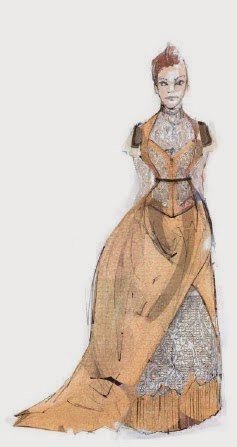
Alfredo, by Jacob A. Climer
When set designing an opera like La Traviata, that is such a staple of the opera repertoire, one has to reflect on why they want to create a new production of it as opposed to a rental.  La Traviata is one of those operatic staples that has become one of the most produced operas.  Its popularity is inherent: the music is absolutely gorgeous, the characters have a lot of room for depth, and the story is heartbreaking. 

Violetta, by Jacob A. Climer
I grew up reading George Sand, Alexandre Dumas (père and fils), Zola, and Flaubert.  La Dame aux Camélias, which is the inspiration for La Traviata, is a novel that is part of the French school curriculum.  I was therefore very familiar with the story, but I did not know the music as intimately.  I have always loved reading books about passionate women fighting conservative societies.  When I first met with Stage Director Chas Rader-Shieber, I found he had the same respect and fascination for this “fallen woman” as I do.  I was very excited by everything he had to tell me about her motivations and how he saw the story unfold.

From the beginning of our creative meetings, Chas explained he was not interested in the classic giant chandelier, red couch production aesthetic. Chas wanted a fresh take on it. Together with Costume Designer, Jacob A. Climer, and Lighting Designer, Mike Inwood, we developed a world that felt 1880-period, but relevant enough for a contemporary audience to connect with.

Flora, by Jacob A. Climer
"My inspirations come from many places. Period details are as important as what walks the runway today. But what trumps all, is the importance of clear and appropriate storytelling. With this production we play a lot with dichotomy. Bound vs. free. Respectable vs. reprehensible. Fantasy vs. reality. My goal is to address these underlying conflicts of the piece with my design."

- Jacob A Climer, BLO Costume Designer

We played a lot with the proportion scale of the production. The characters are going to feel like their world is much bigger than they are. We also slightly changed the settings, so the drama first begins at a champagne party at Violetta’s, then outdoors in the countryside, then at a very late night 4:00am party in Paris, and back to Violetta’s empty apartment.

I cannot wait to share this production with you starting this Friday!  Here is a sneak peek of some of the process images for the production.

La Traviata set model, designed by Julia Noulin-Mérat


Thursday, October 2, 2014

DR. VON LYRIC AND PART 2 OF HIS LISZTOMANIA (sorry – irresistible!)

I checked out the interesting - if extended - Wikipedia article on "courtesans" and their history. BLO's Stage Director for La Traviata, Chas Rader-Shieber, is making a strong point in his staging about the difference between the society and worlds of the courtesan and the prostitute, and I was led to a book of synonyms (which often give a clue to a word's wider connotations beyond it's dictionary definition). Here is the list (partial) of what I found under "courtesan" (the line of demarcation between "courtesan" and "prostitute" is obviously ever flexible).

"Prostitute, street walker, harlot, whore, trollop, doxy, strumpet, hussy, trull, drab, hooker, floozy, wanton, chippy, call girl, tart, slut."

Strung out one after another, the total picture is surprisingly shocking to me in its sense of degradation and palpable misogynistic disgust. In contrast, the list of words and synonyms under "lover" seem bland (almost polite) and mostly non-confrontational.

"Beau, swain, wooer, suitor, gallant, amorist, playboy, stud, philanderer, paramour, rake, libertine, cavalier, flirt, infatuate, courter."

A list of the quite nasty things that were said about La Traviata at its various premieres and first performances (the London critics were particularly rough):
  • " ... permeated with foul and hideous horrors."
  • "...the music has no value whatever."
  • "It has pretty tunes, for every Italian has, more or less, the gift of melody; but even tunes are trite and common."
  • "Trash...the poorest music...poorly sung."
  • "Consumption for one who is to sing! A ballet with a lame Sylphide would be as rational." 

The premiere in Venice was one of the low points in Verdi's professional life.
  • "La Traviata last night - a fiasco. Was it my fault or the singers? Time will tell."  
  • "The worst of it was they laughed. They will hear it again - and we shall see!"
  • "I believed I had done something passable, but it seems that I was wrong." 

But he was right - time told, they heard it again, it wasn't his fault and La Traviata has become (according to some) the most popular opera ever written. (So prove it...OK...see below.)

For my (almost) last list of the day, here are the top 10 performed operas (world-wide) in the 2012/13 season. And this is certainly the MOST PREDICTABLE list of all time. In order 1 - 10: 
  1. LA TRAVIATA (see, Giuseppi, those who valiantly stay the course might just win in the end)
  2. CARMEN
  3. LA BOHEME
  4. THE MAGIC FLUTE
  5. TOSCA
  6. MADAMA BUTTERFLY
  7. THE BARBER OF SEVILLE
  8. THE MARRIAGE OF FIGARO
  9. RIGOLETTO
  10. DON GIOVANNI 
But in my absolutely last list (for today) things get considerably more interesting. The NEXT 10 are (in order):  DIE FLEDERMAUS, AIDA, THE ELIXIR of LOVE, COSI FAN TUTTE, HANSEL and GRETEL, EUGENE ONEGIN, TURANDOT, NABUCCO, I PAGLIACCI, IL TROVATORE.
( NABUCCO? ...who knew?)

Check all this out (and much, much more) on a really cool site...operabase.com. (Great statistics!)

See you at La Traviata!

Monday, September 29, 2014

DR. VON LYRIC MAKES A LITTLE LIST


This time I veer away from the YouTube highway and stroll down pathways of my own devising. I guess I might call it phase one of DR. VON LYRIC'S OPERATIC BOOK OF LISTS. As I mentioned in my last post remembering Licia Albanese and her amazing 105-year life span, I am fascinated by chronology - the seemingly random or coincidental juxtaposition of events and people that are thrown together by the fortunes of the calendar. They might reveal mysterious cosmic forces at work (or not). Anyway, here is a list of "things" that happened in 1853 - the year of the premiere of La Traviata at La Fenice in Venice. 

  • First railroad through the Alps (Vienna - Trieste)
  • Wellington gigantea, the largest tree in the world, discovered in California
  • Napoleon III marries Eugénie de Montijo (Another fascinatingly long-lived figure – she was born in the year Thomas Jefferson died and died in the year Beniamino Gigli made his Met debut and F. Scott Fitzgerald wrote This Side of Paradise.)
  • Vincent van Gogh and Carl Larsson born
  • Henry Steinway begins manufacturing pianos in NYC
  • Franklin Pierce inaugurated as 14th President of  the U.S.
  • Wagner completes text of the Der Ring des Nibelungen
  • The Crimean War between Russia and England breaks out
  • Georges-Eugène Haussmann begins reconstruction of Paris by tearing great swaths of it down
  • and...Verdi had ANOTHER premiere (Two months earlier than the La Traviata opening, Il Trovatore opened in Rome)  

A (inevitably partial) LIST OF OPERAS (familiar and obscure) set in Paris (or environs):
  • La Traviata
  • ·        La Bohème
  • La Rondine  
  • Il Tabarro
  • Manon
  • Manon Lescaut
  • Le Jongleur de Notre-Dame
  • Thérèse
  • The Ghosts of Versailles
  • Andrea Chénier
  • Danton’s Death   
  • Louise (and its sequel Julien)
  • Adriana Lecouvreur
  • Les Huguenots
  • Capriccio
  • Fedora
etc....etc....etc...fill in at your leisure.

Maybe this was a bad idea - as I type, the list now seems endlessly…fascinating?...pointless? Most certainly Paris is the operatic capital of the world (in this sense). Any challengers? Any nominees for second place? Rome? (oddly) Seville?

Well...enough for today...will follow up in our next chat with some more lists. 

Friday, September 26, 2014

La Traviata - Love for Sale

By Magda Romanska, Ph.D., Boston Lyric Opera Dramaturg

In the first volume of his sprawling 19th-century novel, In Search of Lost Time, Marcel Proust chronicles the tale of Charles Swann, an upper-class member of French society, and his obsessive love for Odette de Crécy, a popular and attractive Parisian courtesan. Although Swann is able to buy Odette’s time and body, he is unable to buy her thoughts and feelings, and he is reduced “to utter confusion” when suddenly forced “to perceive that Odette had an existence which was not wholly subordinated to his own.” “When Odette had just done something which she did not wish to disclose, she would take pains to conceal it in a secret place in her heart,” which Swann, no matter how much money he spent, could not access. Since Odette’s material well-being—and survival—wholly depended on being wanted and desired by men who supported her, Swann was never able to tell whether “her love for him was based on a foundation more lasting than . . . mere commercial interest.” Unable to possess all of her, Swann grows increasingly obsessed and eventually decides to marry her, convinced that he will finally be able to reach her, but to his surprise, even as his wife – legally bound to obey him – Odette remains unreachable, leaving Swann in “the painful and continuous anxiety which dwelt in his mind.”

“A ‘kept’ woman—an iridescent mixture of unknown and demoniacal qualities,” Odette is a quintessential courtesan of her era, quixotically enigmatic, inscrutable, and self-possessed. Although it captures a particular lifestyle of upper-class French society at the turn of the century, Proust’s novel is also perhaps one of the better psychological and philosophical treatises of the complex and enduring question of love, sex, and money. What can and cannot be bought, and for what price? From Dumas’ 1848 The Lady of the Camellias, on which Verdi’s La Traviata is based, to contemporary movies like 1990’s Pretty Woman, with Julia Roberts, and 2001’s Moulin Rouge!, with Nicole Kidman, male artists have been fascinated by the idea of the “kept” woman, and Verdi’s heroine is just one of the many “kept” women who recur in art, literature, and opera. La Traviata, the title of which literally translates as “The Fallen Woman,” tells the story of Violetta Valéry, a beautiful courtesan of Paris, and Alfredo Germont, a young and idealistic man from a respectable provincial family. In the story, and many others that followed, Violetta is the prototypical ‘whore with the heart of gold’ who rejects her lover as the ultimate proof of her devotion, aware that association with her will most likely ruin his future societal prospects. Thus redeemed by her selfless sacrifice, Violetta is finally accepted by Alfredo’s family, which nonetheless doesn’t save her, as she ends up dying from tuberculosis to her lover’s despair.

Roland Barthes noted that the myth of the Lady of the Camellias is “probably the most popular feminine myth of the bourgeois era” (quoted in Salo: 61). The purified and idealized image of Violetta (and of all other Fallen Women of the era modeled on her story) captures the socioeconomic incongruities of the 19th century’s changing gender relations, particularly the transition from courtesan to trophy wife as the ultimate symbol of male economic status. The 19th century was dominated by the idea of the upper-class “lady” of leisure. Labor was considered vulgar and “unclean;” only women of the lower classes worked, and their options were significantly limited to menial household jobs or agrarian fieldwork. To afford a leisurely, ladylike lifestyle, a woman needed a man who could support her. Conversely, to be considered successful, a man needed a ladylike woman whom he would support. At first, the position of “lady” was occupied by high-class courtesans, but with the emergence of the bourgeois class, the status of woman of leisure was taken up by the trophy wife. 

In 1899, in The Theory of the Leisure Class, Veblen argued that while upper-class men were required to devote themselves solely to the pursuit of wealth, their courtesans and, later, wives became “decorative objects,” fully devoted to the pursuit of a ladylike ideal, which testified to their husbands’ wealth and power: “In order to gain and to hold the esteem of men it was not sufficient merely to possess wealth and power. The wealth and power must be put in evidence, for esteem is awarded only in evidence” (36). The courtesan, and later, the trophy wife, highly decorated in expensive dresses and jewelry, and requiring a cohort of servants to attend to her and her elaborate wardrobe, provided evidence of a man’s wealth: “Women are highly valued, both as an evidence of wealth and as a means of accumulating wealth” (Veblen 53). It became a woman’s main objective to conform to the role of “trophy,” displayed for the same purpose that hunting trophies were displayed. The display of wealth was simply part of the new economic reality. The rise of capitalism required a well-defined system of economic indicators that would differentiate the newly-emerging bourgeois class from the rest of the society, but that would also provide a system of indicators by which males could recognize among themselves the most successful of the group.  Thus, the display of courtesans, wives, and hunting trophies allowed for recognition of the leaders whom others could profit from, flatter, and emulate. An expensive courtesan, like other commodities, symbolized a male’s status quo: he could afford to pay for her leisure. The more expensive her lifestyle, the better it reflected on the man who supported it, and the better it showcased his social and economic status.

Contrary to the mythology, the real-life Violetta, Marie Duplessis (1824–47), on whom Dumas’ heroine was based, was a pragmatic and keen businesswoman. In a letter to one of her prospective lovers, she wrote quite candidly: “Monsieur le baron, I realize that mine is a sordid profession, but I must let you know that my favors cost a great deal of money. My protector must be extremely rich to cover my household expenses and satisfy my caprices.” With few viable options for a dignified life, it’s no wonder that 19th-century women remained enigmas in the eyes of men of their era. Out of necessity, from navigating and surviving in such a world, only a woman could know the “secret place in her heart.” Like Proust’s Odette, Verdi’s Violetta’s character and motivations are scrutinized thoughtfully, revealing the paradoxical relationship between love and money. After all, can love ever be bought, or can it only be given freely by a free human being, and what does it really mean for a woman to love freely in an unfree society?

The Ruined Maid
by Thomas Hardy, written in 1866 

“O ’Melia, my dear, this does everything crown!
 Who could have supposed I should meet you in Town?
 And whence such fair garments, such prosperi-ty?” —
 “O didn’t you know I’d been ruined?” said she.

 — “You left us in tatters, without shoes or socks,
 Tired of digging potatoes, and spudding up docks;
 And now you’ve gay bracelets and bright feathers three!” —
 “Yes: that’s how we dress when we’re ruined,” said she.

 — “At home in the barton you said ‘thee’ and ‘thou,’
 And ‘thik oon,’ and ‘theäs oon,’ and ‘t’other’; but now
 Your talking quite fits ’ee for high compa-ny!” —
 “Some polish is gained with one’s ruin,” said she.

 — “Your hands were like paws then, your face blue and bleak
 But now I’m bewitched by your delicate cheek,
 And your little gloves fit as on any la-dy!” —
 “We never do work when we’re ruined,” said she.

 — “You used to call home-life a hag-ridden dream,
 And you’d sigh, and you’d sock; but at present you seem
 To know not of megrims or melancho-ly!” —
 “True. One’s pretty lively when ruined,” said she.

 — “I wish I had feathers, a fine sweeping gown,
 And a delicate face, and could strut about Town!” —
 “My dear — a raw country girl, such as you be,
 Cannot quite expect that. You ain’t ruined,” said she.


Read more:
 
Cross, Milton. Complete Stories of the Great Operas. 1st ed. Garden City, NY: Doubleday, 1947. Print.

Dumas, Alexandre. Camille: or, The Fate of a Coquette. Philadelphia: T. B. Peterson & Brothers, 1880. Print.

Edwards, H. Sutherland. Famous First Representations. London: Chapman and Hall, 1886. Print.

Kavanagh, Julie. The Girl Who Loved Camellias: The Life and Legend of Marie Duplessis. 1st ed. New York: Alfred A. Knopf, 2013. Print.

Martin, George Whitney. Verdi: His Music, Life and Times. New York: Dodd, Mead, 1963. Print.

Parker, Roger. The New Grove Guide to Verdi and His Operas. Oxford; New York: Oxford University Press, 2007. Print.

Proust, Marcel. In Search of Lost Time (À la recherche du temps perdu, published in seven volumes, 1913–27). Volume 1: Swann’s Way (Du côté de chez Swann, sometimes translated as The Way by Swann’s). Paris, 1913. Print.

Remarks on the Morality of Dramatic Compositions, with Particular Reference to “La Traviata,” etc. London: J. Chapman, 1856. Print.

Roberts, Nickie. Whores in History: Prostitution in Western Society. London: HarperCollins, 1993. Print.

Sala, Emilio. The Sounds of Paris in Verdi’s “La Traviata.” Trans. Delia Casadei. New York: Cambridge University Press, 2013. Print.

Veblen, T. The Theory of the Leisure Class: An Economic Study in the Evolution of Institutions. New York; London: Macmillan, 1899. Print.