Forward

Showing posts with label The Lighthouse. Show all posts

Friday, February 10, 2012

What's for Dinner on THE LIGHTHOUSE?

If you're on a Scottish lighthouse in 1900, it's a family style plate of oatcakes and pilchards. At least, those are the two items mentioned in the libretto of Peter Maxwell Davies' opera The Lighthouse. As the Assistant Stage Manager in charge of props, food preparation falls into my domain, but I'll admit I did enlist the help of fellow ASM Ginger Castleberry when plating the most pungent of the fish.

We learned from our British director Tim Albery, British conductor, David Angus, and Canadian designer Camillia Koo that oatcakes are a familiar sight in English and Canadian grocery stores, but they were not as easy to find in Boston. A specialty shop in Harvard Square carried some, but finally, our props master ordered the preferred brand online for us to use for the show.

The creative team wanted to stay faithful to the story and have the singers eat real pilchards (canned fish), so we brought a variety of sardines to try. Packed in oil? Too messy. Packed in water? Just as smelly. With mustard? Didn't help the appeal. After a couple rounds of deli meat cut in strips stage management hoped would pass as pilchards, the winner was canned chicken - a little bit flaky like fish and moist enough to be palatable for the singers to eat between lines in the opera.

Wash it all down with water dyed brown to look like tea (most performers don't like to drink caffeine during a show), and you've got a balanced lighthouse meal. Don't forget to save some for the rats!

--Courtney Rizzo, Assistant Stage Manager

Thursday, February 9, 2012

Lighthouses in peril

Thanks to everyone who joined us last night for the opening performance of our third Opera Annex, The Lighthouse. Join us tonight for another stunning performance and prepare yourself with this video of lighthouses in peril. The music is Mozart's Requiem, but perhaps it should be Verdi's Requiem ...


Know of other haunted, perilous lighthouse locations? Share them in the comments.

Wednesday, February 8, 2012

The Ghost of the Lady Light Keeper

Fourth and final in our series of haunted lighthouses:

Location: Gurnet Point/Plymouth Bay
Station Established: 1768
First Lit: 1843
Operational: Yes
Automated: 1986

Near to where the Pilgrims came ashore in the New World, stands one of America's earliest lighthouses, at Gurnet Point in Plymouth, Massachusetts. Originally two towers were built and were first lit in 1769.  John and Hannah Thomas were appointed the keepers of both lighthouses since the towers were constructed on their land.  Shortly after taking the post John left to fight in the Revolutionary War and left Hannah to keep the lights burning all by herself.

John never came back from the war, and in 1790, Hannah was appointed the first female lighthouse keeper in America. In 1801 both towers caught fire and burned to the ground.  The towers were replaced, but the northeast one was dismantled in 1924. Hannah loved the lighthouse and remained as keeper until 1790. Ever since Hannah’s death people have said they have seen her ghost in and around the tower. 

Night at Gurnet Point – Lighthouse Photographers Bob and Sandra Shanklin had the opportunity to stay the night in the keeper’s house on Gurnet Point. 

Told in their own words: At some point, something woke Bob. He raised up on his elbow and watched the light come around, illuminating the windows for a few seconds each time. Then he looked over toward me (Sandra), who was sleeping soundly. Above me, he saw the head and shoulders of a woman. He described her as being a green blue electric spark color. He said she had an old time hairdo, sunken cheeks and the saddest face he ever saw. Bob told me that she wasn't wrinkled and he didn't think she was an old woman. He said he felt no threat from her, but only her sadness. As he watched her, out of the corner of his eye he could see the rays of light from the lighthouse come around several times, brightening the room. He looked toward the light, then looked back to where she had been and she was gone. While there is no way to ascertain with any degree of certainty the identify of the Gurnet Point ghost, Shanklins claimed he had a "feeling" it was Hannah Thomas.

--Kalina Schloneger, Education & Community Programs Intern

-------------------------------------------------------------
Resources/for more about this haunted lighthouse visit:
-------------------------------------------------------------
See our haunting production of Sir Peter Maxwell Davies' The Lighthouse, Feb. 8--12

Tuesday, February 7, 2012

A word about the music of 'The Lighthouse'


BLO Music Director David Angus shares his thoughts about the music of The Lighthouse.

One of the most entertaining things about Sir Peter Maxwell Davies' opera, The Lighthouse, is what he does with the little orchestra. There are only 12 players, but they play more than 30 instruments between them, including some very unusual combinations. At the more serious end, he creates wonderful eerie effects with strange harmonics, flutter-tonguing, glissandi, etc., sometimes extremely quietly, so that the instruments sound totally alien. However, for me the greatest fun comes in the loudest parts, which can be totally deafening! The quieter instruments, such as the violin, viola and guitar, wouldn't be heard at all, so instead he asks the players to play percussion instruments, and they really enjoy themselves!  Our concertmaster, Sandy Kott, smashes the giant Tam-Tam (gong) several times, and the guitarist thumps the big bass drum like a heartbeat throughout the double climax. But for me the best is that our soft-spoken principal Viola, Kenneth Stalberg, is given two flexatones, one in each hand, and he makes as much sound as he can, shaking both of them as hard as possible. (I'm sure there is a viola joke in there somewhere!) He told me that he had been practicing playing the flexatone weeks before the first rehearsal. The final noise at the end comes from the pianist who, as well as attacking the inside of the piano with a drum stick, blows a referee's whistle as loud as he can. It is total chaos!

"Max" has written possibly the most difficult music for orchestra that I have ever come across; each part is like a virtuoso concerto solo. Our players are achieving the impossible, by playing all the notes (and in the right order!) perfectly synchronized with each other, whilst still being flexible enough to follow the singers. Our singers are, if anything, even more impressive, because their music is just as difficult, but they have to do it all by memory, while acting and sometimes even while lying on their backs or climbing up and down ladders. When you add all this to an intelligent and clear staging on a striking set that has been magically lit, you have the recipe for something extraordinary!

Monday, February 6, 2012

The Ghost of a Pirate's Wife

Third in our series of haunted lighthouses:

Location: Sippican Harbor off of Buzzards Bay
Station Established: 1819
First Lit: 1889
Operational: Yes
Automated: 1997
William S. Moore (alleged pirate) took the post as keeper of the Bird Island Lighthouse in 1819 after having fought in the War of 1812. Supposedly he owed the U.S. government money and this position repaid his debt.  He brought with him his wife, who was a heavy tobacco user, and suffered from tuberculosis. Mrs. Moore was forbidden to leave the island by her husband, since he feared she would be unfaithful.

The lighthouse was damp and lonely which worsened Mrs. Moore’s illness and need for tobacco.  The townspeople said they could hear her cries of desperation and would sneak bags of tobacco out to the lighthouse when they could.  One evening Moore raised the distress flag and when the townspeople arrived to help they found Mrs. Moore dead.  Moore insisted that his wife had died from her disease but some townsfolk believed otherwise.  Moore demanded that his wife be buried on the island so she was laid to rest right next to the lighthouse.  Moore was always blamed for the death of his wife and for holding her captive on the island.  Legend has it that keepers have been haunted by Moore’s wife ever since, the ghost of a hunched-over old woman, rapping at the door during the night.

--
Kalina Schloneger, Education & Community Programs Intern
-------------------------------------------------------------
See our haunting production of Sir Peter Maxwell Davies' The Lighthouse, Feb. 8--12

Friday, February 3, 2012

Tech Week for THE LIGHTHOUSE

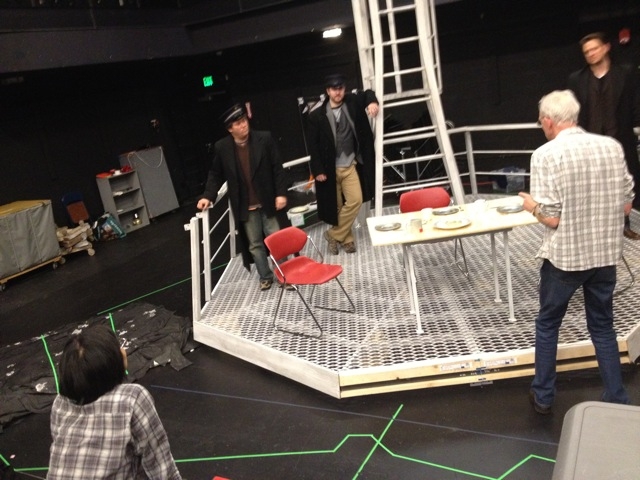
The cast explores the space under the platform,
new to them in the performance space.
Tech week for an opera is always an exciting time: it’s a chance to finally incorporate lighting with full scenic elements and to transform the space where the show will be performed. Our singers for this production of The Lighthouse are, aside from being top-notch singers, great actors who have a lot of flexibility. The transfer from the studio to the stage can be daunting, especially in a show like this where we didn’t have the luxury of having the underside of the main platform available; however, our gentlemen were excited to explore the possibilities available to them by now having the complete set in the real space. The lighting design is one of the most exciting parts of the technical rehearsal process. Our designer, Thomas Hase, has enhanced the story telling that has been created in the staging to portray a menacing, dark world on a remote island. The Kennedy Library has truly transformed into the Flannan Isles …

--Crystal Manich, Assistant Director

Tuesday, January 31, 2012

Week 2 Roundup of 'The Lighthouse' rehearsals


David Cushing and John Bellemer sport their costumes
coupled with their blue jeans in rehearsal.

As The Lighthouse came together quite well during the second week of staging in the rehearsal space, we were able to start seeing the process of the singers turning into their characters as more and more of the real costumes were integrated into rehearsal. For the first week we had rehearsal items of what they will be wearing but, as always, it was helpful to get the real items once the costume shop has completed making them. It was fantastic to see the singers working in their jeans coupled with their actual shirts, vests and jackets. 1900 meets 2012. But even with half a costume, the clothes cause a transformation and make the characters real. This week we also obtained real oatcakes from a specialty UK store in Cambridge, since the opera calls for the men to be eating them: “…it’s tea, and no bread! It’s oatcakes!” exclaims a bitter Blazes. I really enjoyed them, but a few of the other staff in the room didn’t care for their dryness. They are great with tea!

--Crystal Manich, Assistant Director

Monday, January 30, 2012

A Haunted Tower Built on the Sea

Second in our series of haunted lighthouses:


Location:  COHASSET ROCKS
Station Established: 1850
Current Tower First Lit: 1860
Operational: YES
Automated: 1947

Minot's Ledge lighthouse was a place no sane person wanted to live. It is just a tower coming out of the sea on a reef located off Scituate, Massachusetts.  In fact, the first tower was destroyed by the sea only a year after it was completed!  In April of 1851 keeper John Bennet went ashore leaving his two assistants in charge of the lighthouse.  While Mr. Bennet was on land, winds kicked up to more than 100 mph and he could not return to the lighthouse until morning.  When keeper Bennet finally made it back to the lighthouse there was nothing left of the tower.  The bodies of his two assistants washed up later on Nantasket Beach and Gull Island.  Since this tragedy fishermen say they hear cries coming from the island and swear they have seen a man hanging from the ladder screaming to passers by “Stay away! Stay away!”

After the tragedy on Minot’s Ledge other strange things began to happen.  When an assistant was ordered to clean the lighthouse the windows would always be sparkling clean by the time they reached the top to complete the task.  Other keepers heard taps echoing up through the stairs.  This was the signal for the two assistants that they could leave their post. Most keepers learned to live with the ghosts but others lost their minds.  One keeper could not handle it and slit his own throat another went insane and had to be taken from the lighthouse in a straight jacket.

--
Kalina Schloneger, Education & Community Programs Intern

-------------------------------------------------------------
Resources/for more about this haunted lighthouse visit:
-------------------------------------------------------------
See our haunting production of Sir Peter Maxwell Davies' The Lighthouse, Feb. 8--12

Thursday, January 26, 2012

Strange and spooky origins


The story of The Lighthouse caught the fascination of myself and fellow assistant stage manager, Ginger Castleberry, when we looked up the location of the historical events on which the opera is based, see it on a map: http://g.co/maps/gmzw7

Who knows what really happened on this isolated group of rocks? The real-life Northern Lighthouse Board investigation (the opera's Court of Enquiry) concluded that all three lighthouse keepers were swept out to sea by a powerful wave, but no bodies were ever found washed ashore …

Ginger and I initially theorized the Loch Ness Monster was to blame for the disappearance of the men. After all, Nessie would have been hungry after a 300-mile swim between Loch Ness and the Flannan Isles. However, when we staged the final moments of the opera yesterday, director Tim Albery has provided us a more intriguing—and plausible—interpretation of the final moments of the keepers. The score blurs past and present in a way that gave us clues of how the story could fit together. With only a three person cast, the singers have been delving into the mystery from the perspective of the lighthouse keepers when they were confined together on duty, the relief officers who discovered the empty lighthouse, and impartial narrators after the whole event. You'll have to come and see to be your own judge of the keepers' fate!

--Courtney Rizzo, Assistant Stage Manager

Tuesday, January 24, 2012

Visiting the performance space for 'The Lighthouse'

Late last week The Lighthouse cast and creative team headed out to the Kennedy Library where BLO will produce the piece. We are charged with the exciting challenge to create an opera in a non-traditional space. The room that will be our “stage” at the Library overlooks Boston Harbor and is the perfect location to create a lighthouse. 

The cast of The Lighthouse examine the unfamiliar performances space.
We took the set model with us. In the creation of a new production a set model is built by the designer, in our case Camellia Koo, and enables us to visualize the space as a new and different world. Standing there without the context of the model it would have been difficult to imagine a room used mostly for conferences and public talks converted into a mysterious lighthouse on a remote island located north of Scotland. When we looked at the model and moved around the space to see the placement of each piece, I became excited about the transformation of which we are about to be a part. The view of the bay behind our lighthouse will make the audience feel as if the lighthouse is truly there. This kind of theatrical expression of opera isn’t done as often as it should. That is a pity, for what is more operatic than being in the story yourself?

--Crystal Manich, Assistant Director

Monday, January 23, 2012

Haunted Lighthouses

The lighthouse of Sir Peter Maxwell Davies' opera is not the only lighthouse with a scary and mysterious tale.

Discover the haunted lighthouses near you as we take you on a tour of the haunted lights of Massachusetts. Tales of other haunted lighthouses will appear each Monday until our production of The Lighthouse opens on February 8.
Stop back for all the spooky details.

The Haunting of America's Oldest Lighthouse
Location: LITTLE BREWSTER ISLAND/BOSTON HARBOR
Station Established: 1716
Current Tower First Lit: 1783
Operational: YES
Automated: 1998

The first lighthouse in America was built on Little Brewster Island and was completed in 1716.  Later the original tower was destroyed during the Revolutionary War. The present tower was constructed in 1783 with 14 additional feet added in 1859. The Lighthouse is said to be haunted by its first two keepers, George Worthylake and Robert Saunders. Both gentlemen died within months of accepting their jobs at the lighthouse. After two disasters, some people believed that the island and its lighthouse might be cursed.

The other tale of the old lighthouse on Little Brewster Island is about its very large bell to help warn ships of the dangerous shore line ahead. Despite the size of the bell the ring will not reach a stretch of water several miles east of the lighthouse. The mariners call this area of sea the “Ghost Walk” because ships can not be reached by the guiding sound of the bell. No one has ever been able to explain the Ghost Walk, not even a team of MIT students who spent an entire summer on Little Brewster Island studying the mystery.

--
Kalina Schloneger, Education & Community Programs Intern

 -------------------------------------------------------------
Resources/for more about this haunted lighthouse visit:
-------------------------------------------------------------
See our haunting production of Sir Peter Maxwell Davies' The Lighthouse, Feb. 8--12

Friday, January 20, 2012

Day 2 of staging The Lighthouse


Assistant Director, Crystal Manich shares some insights into rehearsing an opera. Crystal joins BLO again after working as the Assistant Director for last spring's production of Agrippina. Her interview with Countertenor Anthony Roth Costanzo is here.

David Angus with the three singers of The Lighthouse
The first few days of staging an opera are very exciting: a new group of people has been brought together to create the show ... and no one really knows what to expect. Even though the show plays under 80 minutes, what makes this show particularly challenging is the music. It’s very complicated and intricate. The three gentlemen in this production go over a large section of music with David Angus, our conductor, before putting it onto its feet. This makes for a smoother rehearsal: if the music is fresh, the singers can more easily focus on the staging.

Designer Camellia Koo looks on as Tim Albery leads a staging rehearsal
 Our director Tim Albery creates a really nice atmosphere in the room by providing a clear framework for the piece while also allowing the singers to explore character and movement. It seems that he is also appreciative of his set and costume designer, Camellia Koo, being in the room with us. It’s a rare luxury these days to have a designer be a part of early staging rehearsals. Cami is very helpful when anyone has a question about a costume, a prop or part of the set, and she is able to help make decisions with Tim on the spot as well.

By the end of this week we should be about ¾ of the way through staging the piece. I look forward to seeing where this is going! 

--Crystal Manich, Assistant Director

Monday, January 16, 2012

Building 'The Lighthouse'

This February BLO produces the third annual Opera Annex production; Sir Peter Maxwell Davies' The Lighthouse. In this chamber opera Davies explores the ominous maritime tale of three lighthouse keepers who mysteriously disappeared in 1900 from Northern Scotland’s Orkney Islands. The Opera Annex productions hold a special place my heart because BLO seeks to produce opera in a found space with each Opera Annex. In its first season (2009/2010) BLO brought Britten's The Turn of Screw to the Park Plaza Castle and then in the 2010/2011 Season, BLO transformed the Wimberley Theatre at the Calderwood Pavilion at the BCA into the Emperor's tyrannical world with Ullmann's The Emperor of Atlantis. This season BLO brings the Opera Annex to the John F. Kennedy Presidential Library & Museum

Using a wall of windows overlooking Boston Harbor as the backdrop for the set, designer Camellia Koo created a stunning design--another world of its own. Now, the A.R.T. scene shop is bringing that vision to life. I've had the privilege of observing the set in various stages along the way--beginning with the set model.

Model of the set, created by Koo.
Base of the platform as seen in the set model photo,
in progress at the A.R.T. scene shop.
Crew installs the platform at the rehearsal hall.
As a life-long theatre-geek, I love to see the progression from the designer's vision to finished product. Koo envisioned several pieces to transform Smith Hall at the Kennedy Library  from a hall with a wall of windows to the mysterious world of Davies' The Lighthouse.

Watch a video of the set pieces coming together:

--Karen Robichaud, Design & New Media Manager

Sunday, December 18, 2011

Provocative Opera at 2 Extremes

Last season's Opera Annex production, The Emperor of Atlantis was featured in this article by The New York Times. Our Opera Annex is a fully staged production designed for an alternative space outside the traditional theater environment, all at a lower ticket price. The New York Times praised, The Emperor of Atlantis as the "most tantalizing" production of the 2010/2011 Season in its original review of the production and in this weekend's article includes that same production as one of "the most memorable performances [...] by groups that specialize in the repertory’s extremes, early and new music. And thoughtful, often provocative opera productions figured prominently at both ends."

This season's Opera Annex, Peter Maxwell Davies' The Lighthouse, is modern piece based on the stories about the lighthouse on the Isle of Shoals. The opera is an unforgettably gripping and overwhelming portrait of growing madness and possession. A chamber orchestra and Davies’ own compelling and mysteriously deep libretto, conjure up an isolated world, terrifying and moving. Don't miss it!

Friday, November 4, 2011

Musical men about town

By David Angus, Music Director

Well, tonight’s the opening of Macbeth–very exciting–and we are all winding ourselves up for a high energy performance. The Dress Rehearsal was a big success and the invited audiences were thrilled with it. First Night is always quite a nervous affair, wondering if everything will go right and if the audience will like it, but having such a good Dress Rehearsal sets us up well and means that the nervous excitement should all be positive.


Meanwhile, life goes on, and we are already getting going with the next project–The Lighthouse--in the background. We have been extremely lucky that the composer, Sir Peter Maxwell Davies, happens to be in the USA for a short tour at the moment, and is spending nearly 3 days in Boston. He lives on a remote island off the north of Scotland and is 77 years old, so he doesn’t travel to the US very often any more. He will be attending Macbeth tonight, but I spent most of yesterday with him.

We began with a visit to the JFK Memorial Library, where we will perform his Lighthouse, and we showed him around and explained why we had chosen that location. I interviewed him (you will be able to see this on our website) and we caught up with each others' news.  We had worked together many years ago at Glyndebourne Opera and had also crossed paths at the Scottish Chamber Orchestra a few times. We also both studied at the Royal Northern College of Music in Manchester, and both began our careers as music teachers in schools, so we have a lot of common background.
The view of Boston from Smith Hall, our venue for The Lighthouse
 Sir Peter, or “Max” as we all know him, is a remarkably sprightly man with a very alert mind, and he is highly articulate, so talking with him is very stimulating. I found out many new things about the opera, including several very spooky coincidences which you will hear about on the interview. 

We visited the museum while we were there and were taken back in time to our childhood memories by all the history and artifacts of that time. It was a real nostalgia trip. When JFK was assassinated I was an 8-year-old at boarding school in Cambridge, and Max was studying over here at Princeton. We both remembered clearly hearing the awful news.

We travelled back into Boston for a lovely lunch of Scallops at Legal Seafoods, where the waiter turned out to be a Musicology Major from Harvard, who was thrilled to meet Sir Peter–what a coincidence!
The trip ended with a visit to see the set for the Lighthouse under construction in Cambridge, and to have the model explained. Everyone is very excited about the whole concept and it is really going to be a very strong show.

We finished the day with a lovely dinner at the home of Esther Nelson, our General and Artistic Director, with some VIP guests and a delicious meal cooked by her husband, Bernd. All in all, a great way to relax before tonight’s big event!