Forward

Showing posts with label Agrippina. Show all posts

Friday, January 20, 2012

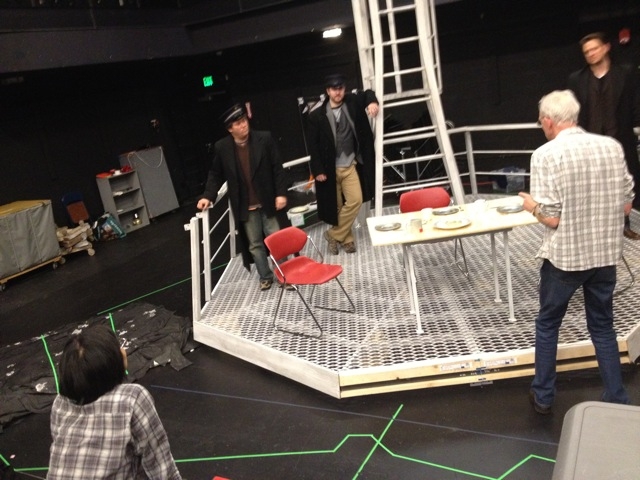
Day 2 of staging The Lighthouse


Assistant Director, Crystal Manich shares some insights into rehearsing an opera. Crystal joins BLO again after working as the Assistant Director for last spring's production of Agrippina. Her interview with Countertenor Anthony Roth Costanzo is here.

David Angus with the three singers of The Lighthouse
The first few days of staging an opera are very exciting: a new group of people has been brought together to create the show ... and no one really knows what to expect. Even though the show plays under 80 minutes, what makes this show particularly challenging is the music. It’s very complicated and intricate. The three gentlemen in this production go over a large section of music with David Angus, our conductor, before putting it onto its feet. This makes for a smoother rehearsal: if the music is fresh, the singers can more easily focus on the staging.

Designer Camellia Koo looks on as Tim Albery leads a staging rehearsal
 Our director Tim Albery creates a really nice atmosphere in the room by providing a clear framework for the piece while also allowing the singers to explore character and movement. It seems that he is also appreciative of his set and costume designer, Camellia Koo, being in the room with us. It’s a rare luxury these days to have a designer be a part of early staging rehearsals. Cami is very helpful when anyone has a question about a costume, a prop or part of the set, and she is able to help make decisions with Tim on the spot as well.

By the end of this week we should be about ¾ of the way through staging the piece. I look forward to seeing where this is going! 

--Crystal Manich, Assistant Director

Thursday, May 12, 2011

Flashback: Caroline Worra

Tastee McBea shares another one of her intriguing opera interviews with Caroline Worra, who recently played the title role in our production of Agrippina.

Read the interview.


Wednesday, March 23, 2011

A Gripping 'Agrippina'

Who can get enough opera puns from Agrippina? We've selected such witticisms:

If it ain't baroque, don't fix it.

We're going for baroque.

Can you Handel Agrippina?

Is Agrippina too hot to Handel?

Seriously, the puns floweth. All this to say that Clio C. Smurro The Harvard Crimson posted a review of Agrippina titled A Gripping 'Agrippina'. Fitting, yes?

- The BLO Bunch

Monday, March 21, 2011

Fun + Opera = 'Agrippina'


After a fun night at the opera (fun and opera in the same sentence? Who knew?) and some mingling with the BLO Bunch after the show, I have to reflect on some highlights of BLO’s production Agrippina. Overall I was pleasantly surprised by my experience at Agrippina. I knew a little bit about Baroque opera before the show  (mostly thanks to this blog), but I definitely was not expecting to laugh as much as I did. From David Trudgen’s portrayal of Nerone as a spoiled, cocaine snorting, martini-toting mama’s boy; to the girl talk scene in which Agrippina (Caroline Worra) gets Poppea (Kathleen Kim) unwillingly drunk, I was laughing, along with the rest of the audience, for most of the show.

When I wasn’t laughing, I was feeling sorry for Ottone, the one true honest character in the show.  Ottone’s aria in the 2nd act where he learns everyone believes him to be a traitor because of a lie started by Agrippina was just heart-heartbreaking. Countertenor Anthony Roth Costanzo’s soothing voice emphasized the innocence of Ottone and made the audience sympathize with the character even more.

What stood out for me the most (fabulous singing aside, of course), was that the show took the extravagant, corrupt characters from centuries ago and made them hilariously relevant and appealing to us in 2011. From the costumes to the subtle choices made by each character, this production made this ancient story feel applicable in many ways to modern times.

Overall, Agrippina combined aesthetically pleasing sets and costumes with tremendously talented singers (who appeared with such natural ease and comic timing upon the stage) to create a refreshing take on one of Handel’s classic works.

- Katie McNamara, Saint Anselm College 

Saturday, March 19, 2011

Agrippina: Tufts Daily

Emma Bushnell of the Tufts Daily reviewed BLO's production of 'Agrippina'! Check out what she has to say.

'Agrippina' offers a gripping opera experience.

Monday, March 14, 2011

Tips for Handel-ing a Baroque Opera!

With all this talk of BLO’s current production Agrippina and references to Handel, the baroque period, counter tenors and the like, there have been various opera terms thrown about in conversation that may have you scratching your head. Well if this is the case, then we’ll answer all of your baroque questions and prepare you for Agrippina!

The Baroque period generally refers to the years between 1600 and Handel’s death in 1759, and is credited as the period in which opera became a musical form. It was in the baroque era that operas were no longer strictly for select groups of people – opera became a recognized art form supported by ticket sales. Many baroque operas are comedic in nature, and were influenced by the Commedia dell’arte (or Comedy of art) type of improvisational theatre that developed in the 16th century Italy. In the early 18th century, two distinct types of operas were developing: the Opera Seria and the Opera Buffa.

Agrippina is an example of an Opera Seria, and refers to the serious style of opera that was considered to be the opera of the court, monarchy and nobility. When early Baroque operas combined broad comedy with tragic elements it struck people the wrong way and sparked the first of many opera reforms (out of which came the Opera Seria) . The genre made famous the da capo aria, an aria consisting of  three sections: an A section which establishes a certain tempo and mood, a B section which offers a contrasting tempo and mood, and then a return to the top (“da capo”) to repeat the A section which the singer is expected to add ornamentation.

In contrast to the Opera Seria, the Opera Buffa, which was developed parallel to the former, first used as a description of Italian comic operas characterized by everyday settings, local dialects and simple vocal writing. They usually involved the use of comic scenes, characters and plotlines in a contemporary setting, and generally had 2 acts and dealt with comic situations. The Opera Buffa used the lower male voices to exclude the countertenors and castrati so commonly used in Opera Seria.

Many operas during the baroque period engaged in gender-bending since there were roles written for castrati but they weren’t always available. The interchangeability of men and women’s voices resulted in men being cast as women (especially in parts of Italy where women were banned from the stage), and women cast as men, and a fair amount of disguises were used.  Counter-tenors (such as the ones Aggripina) are male singers whose vocal ranges are equivalent to that of a contralto, mezzo-soprano or even a soprano; usually through use of falsetto or rarely their normal voices. A Castrato is a man with a singing voice equivalent to that of a soprano, mezzo-soprano, or contralto voice produced either by castration of the singer before puberty.

Another characteristic of Baroque operas is that tragedies were typically given happy endings because operas were originally performed at celebrations – they made sure to resolve all of the plots and subplots in happy endings. As for Agrippina’s happy ending, you will have to attend BLO’s production to find out what type of ending Handel and Cardinal Vincenzo Grimani (who wrote the libretto) had in store for her!

Friday, March 11, 2011

'Agrippina' opens TONIGHT!


Boston Lyric Opera’s production of Handel’s Agrippina opens tonight!

In celebration, we thank Barihunks for mentioning members of this fabulous cast, Christian Van Horn and David McFerrin. You can follow Christian on tumblr and twitter (@VanHornCVH)

Read the post about BLO’s most recent barihunks!

Get your tickets for The BLO Bunch night – March 16.

~ See you at the theatre ~

Tuesday, March 8, 2011

THREE QUESTIONS: Christian Van Horn


Anthony Roth Costanzo takes readers into the world of rehearsing an opera, BLO's upcoming Agrippina.


Our exalted King Claudio in BLO’s production of Agrippina is played by the stellar Christian Van Horn. Christian has appeared in many celebrated opera houses including the Lyric Opera of Chicago Opera (where he is an alumnus of the Lyric Opera Center), San Francisco Opera, Los Angeles Opera, Bayerische Staatsoper, Santa Fe Opera, and the Salzburg Festival. His roles include the title role in Le Nozze di Figaro, Raimondo in Lucia di Lammermoor, Timur in Turandot, Colline in La Bohème, Oroveso in Norma, the Sprecher in Die Zauberflöte, Nourabad in Pearl Fishers, and many others. Not only do we both play the three-name card extremely well, but we also share the same extraordinary managers. To take at look at what they do, visit them at Opus 3 Artists.


ARC

Would you say that there is one thing Handel provides you with as a singer which is distinct from any other composer?

CVH
I would say that Handel really lets you explore a LOT of colors in the voice. The light orchestration allows for a huge dynamic range, rather than just sheer volume. I would say that basses RARELY get to sing pianissimo, and Handel leaves room for that -- especially in the recits.

ARC
You play King Claudio in BLO's Agrippina; is he a good guy or a bad guy and how do you communicate that either vocally or dramatically?
CVH
Claudio is a GREAT guy, even if a bit promiscuous.  As soon as anyone becomes Ceasar his days are immediately numbered. This is not lost on Claudio, and so he is definitely living for the moment. His heart is good, despite his lack of fidelity. After all, Agrippina (his wife) does not exactly make it easy for him to be faithful to her. Vocally, I think Claudio must be very powerful -- at times. He needs to make it clear who the boss in the room is, especially when there are many characters present. Claudio's softer side must also be represented but can really only appear one on one -- with Lesbo, his confidant, or with one of the ladies. 

ARC
In your experience thus far, what's the most fun thing about being a bass-baritone?
CVH
The best part of being a bass-baritone is the characters we get to play. While the tenors and baritones usually get to play the love interest or hero, the basses and bass-baritones generally get to pull the strings and make everyone dance! We often get to play very old men, which presents a fun challenge; and, the "bad guys" are always low voices. Nothing is more fun than playing a bad guy! Also, there are very few operas that don't require a bass-baritone -- which from a practical standpoint is fantastic.   

To read more about Christian, visit his website, www.christianvanhorn.com

Thursday, March 3, 2011

THREE QUESTIONS: Gary Thor Wedow

Anthony Roth Costanzo takes readers into the world of rehearsing an opera, BLO's upcoming Agrippina.

Our brilliant conductor Gary Thor Wedow is unique in his sensitivity, skill, and knowledge of early music. He also has a seemingly bottomless treasure trove of wonderful historical anecdotes that inform the way he crafts opera. Gary went to graduate school here in Boston at the New England Conservatory of Music where he studied with John Moriarty. Later, he was the Associate Conductor of the Handel & Haydn Society. He has conducted an enormous amount of early music: Cavalli, Monteverdi and of course Handel -- no less than 9 Handel operas for New York City Opera, Juilliard, Seattle, and Miami, among others. Next, Gary returns to Seattle to conduct Magic Flute, and then goes to Wolf Trap for Wolff Ferrari's Le Donne Curiose. Gary began our interview with his characteristic exuberance saying that, “It's terrific to come back to Boston where I got a great beginning to a very happy life and I’m so glad to be working with such a dynamite cast in this beautiful and genuinely funny production.”


ARC
Can you explain the fabrication, function, and feeling behind the ornamentation in Boston Lyric Opera's production of Agrippina?

GTW
Ideally the ornamentation comes from the emotional heart of the drama, outlining and embroidering the line both dramatically and melodically.  The character, during the course of the aria goes through an emotional journey and upon the return to the beginning of the aria, their inner life is transformed, so the ornaments reflect the transition or intensification of their emotional life through melody.  There are the 'essential' ornaments: the appoggiatura or leaning note, the messa di voce or spinning out of the note and the trill or warbling, shaking of the voice. Then there are the 'divisions' which divide up one note into many.  Handel's singers (as today's) spent hours training and practicing patterns. As you know, the ornamentation should come from the singer and our beautiful cast has all shaped their own ornamentation.

ARC
We were talking the other day about Handel's life and how it had an impact on his music. Can you speak to the intersection of life and art in Handel's oeuvre as well as in any musician's life?

GTW
Handel for a long time was deified with the virginal morality of the saint. Though he was certainly the composer of heavenly music, his personal life seems very human and emotional. Here is an immensely talented young composer who gets into a quarrel with a fellow composer (Matheson) over who should play the harpsichord in an opera and challenges him to a duel. Later, he becomes the center of a group of wealthy patrons in Italy who were probably gay and where he was known as the Saxon bear; the same circle of intellectual artists surrounded him in London. I feel the evidence points to him being gay and he had a passionate nature and knew well the value of his great gift. I feel an intense responsibility to infuse this music with deep emotion, plugging into primitive and deep wells of primal feelings. Handel felt these emotions first and we recreate and experience these passions ourselves, along with the audience. That's music.

ARC
How do you balance the exigencies of the director, singers, orchestra and administration while trying to craft your take on an opera?

GTW
Bernard Shaw said that opera was an art form which tried to combine five art forms, which is four art forms too many. Everyone feels that their corner of the opera is the most important, and of course they are right because opera needs all of these elements. Music is the heart of opera and if you take good care of your heart, the body is healthy. Opera is all about people; I love people and love working with them, learning from them.  Everyone wants to perform at their optimum, so if you enable people to do their best work, you can fulfill your vision of the opera at the same time.  I'm incredibly grateful and excited to be working on this beautiful opera.

Wednesday, March 2, 2011

Measure your pleasure


You are invited!
The BLO Bunch attends Boston Lyric Opera's Agrippina, a "fun, sexy" opera.
Never attend the opera alone again.

Don’t miss the next event with The BLO Bunch.

 Join The BLO Bunch following the March 16th performance of Agrippina for a students-only reception generously hosted by Jacob Wirth


Where: After the performance at the Citi Performing Arts CenterSM Shubert Theatre (265 Tremont Street), 
head over to Jacob Wirth (37 Stuart Street) to meet up with other members of The BLO Bunch and 
keep the conversation alive!

Bonus: sneak backstage and follow Counter Tenor Anthony Roth Costanzo on the blog!

~ See you at the opera ~


Monday, February 28, 2011

THREE QUESTIONS: Crystal Manich


Anthony Roth Costanzo takes readers into the world of rehearsing an opera, BLO's upcoming Agrippina.

This is the first in a series of posts entitled "Three Questions" where I ask collaborators from the Agrippina team about art, life, and everything in between. My first victim is our production's assistant director Crystal Manich. Crystal, an accomplished director in her own right, just finished helming Handel's Rinaldo for Pittsburgh Opera. She has directed nationally and internationally and received praise from The New York Times and The Wall Street Jouranal, among many other publications, for her extraordinary work. In addition to her engagements as a director and assistant director, she is the co-founder and co-artistic director of Opera Omnia, a company which produces baroque opera. I asked Crystal to elucidate the process of bringing an opera to life:


ARC:
You've just come from directing a Handel opera and will be working on another this summer; while this composer's unique dramatic format is not new to you, does Agrippina represent any firsts, big or small?
CM:
What makes Agrippina unique is the way that Handel writes comedy. The thought that Handel put into deciding whether a text is serious or not is all based on how he sets that text to music.  Musical setting also effects whether a character is telling the truth, lying, flirting, or becoming murderous... the range of possibilities is endless.  Also, as with all Handelian operas, the singer has so much control with regard to the delivery of a line during the recitatives.  One small adjustment, emphasizing a word in one way rather than another, makes all the difference in the world.  Then, of course, one has to consider the physicalization of this text: it's a lot of work!

ARC:
In your experience what role does the atmosphere of rehearsals play in the final product? Can you give us an example?
CM:
Atmosphere in the rehearsal process is essential for the success of a show.  No question.  There is an amazing connection that people build naturally.  Usually it takes less than three days of rehearsal before you feel as if you have known everyone for a long time.  The work is very intimate.  If for some reason there were to be a bad relationship between one person and another, no matter on what side of the stage they work, the performance would be greatly affected.  A positive and nurturing atmosphere guarantees a team effort onstage as well as cohesive storytelling.

ARC:
As a director, do you feel you have a role in changing the face of opera or do you feel there is no change necessary? In creating productions, how can we keep opera alive and relevant?
CM:
I think that opera is just like any kind of live performance: it is always morphing.  That's what good art should do.  When it stops being spontaneous, then it isn't art anymore.  Why would we want to repeat the same staging techniques over and over again?  Puccini (as just one example) wasn't afraid to change the form, so why should we be?  With regard to creating productions, I don't believe in "relevance."  These works survive because there is something universal and true in their stories that is not specific to any time or place.  These are stories about people just like us.  I truly believe that if you present real human relationships onstage--all of the time--then it will always be relevant despite the "style" or time period in which it is set.  It's only when there is dishonesty that it becomes a mere museum piece.  An emperor is a human.  A man who has had his heart broken is no stranger to us.  The greed that is so prominent in Agrippina is recognizable in many aspects of society today.

To read more about Crystal, visit her website: crystalmanich.com  

Friday, February 25, 2011

Backstage with Anthony Roth Costanzo

Anthony Roth Costanzo
Hear from countertenor Anthony Roth Costanzo, featured in BLO's upcoming production of Agrippina (as Ottone). Countertenor Anthony Roth Costanzo began performing professionally at the age of 11 and has since appeared in opera, concert, recital, film, and on Broadway. Anthony will share backstage insights from rehearsals and the life of a singer working for BLO. Email theblobunch@gmail.com with your questions for Anthony!


DA CAPO

The da capo aria is the structural foundation and the emotional heart of baroque opera, and there are no fewer than 16 in Boston Lyric Opera's upcoming production of AGRIPPINA. Da capo translates literally from Italian to mean, "from the head" or, "from the top", and refers to an aria in which there is an A section, followed by a B section, and then a return of the A section (hence, "from the top"). In the recap of the A section, it is customary for the singer, conductor, or both to come up with ornaments and decorations to embroider the original vocal line. In Agrippina rehearsals, as we begin the process of staging this parade of da capo arias, I have been thinking (beyond ornamentation) about the ways in which this strict formal construct can be rendered both extremely human and psychologically revealing. It is easy to construe these arias as undramatic in their repetitiveness, or antiquated in the way they approach narrative. However, through our work with conductor Gary Thor Wedow and director Lillian Groag, we have all been developing the journey of each individual da capo within the context of our characters' arc throughout piece. What I have come to realize is that our minds often work in da capo fashion. For example, the equivalent of an A section in real life might be the thought, "I can't believe this is happening to me". The first time we have this thought, it might be with a sense of trepidation. But our minds, especially in this day and age, rarely stay focused on any one thought for too long... and that is where life's B section comes in: "This morning's bowl of Cracklin' Oat Bran really put me in a good mood." Inevitably, we return to the original thought, but now with more perspective and perhaps a slightly different take. Instead of trepidation, we think with cautious optimism, "I can't believe this is happening to me". We could easily have two dozen such da capo episodes in any normal day, let alone a day when our world is turned upside down, as in Agrippina. Thinking of it this way, I realize that Handel is coloring our internal human processes with his prolific musical ingenuity. I encourage you all to come see how the psychological progression of each da capo aria plays out.

STAY TUNED: More behind the scenes musings, interviews, photos, and gossip to come.

- Anthony

Tuesday, February 22, 2011

Comedy & Irony: 'Agrippina'


Caroline Worra


Let's take a look at the BLO's upcoming production, Handel's Agrippina. The libretto, by Cardinal Vincenzo Grimani, describes the Roman queen Agrippina (CAROLINE WORRA) trying to secure the throne for her son, Nerone (DAVID TRUDGEN).  What happens next is a story full of comedy and irony. 


David Trudgen
Grimani's libretto is full of irony, which Handel reflects in the music (sometimes by having the music completely at odds with the text). His settings sometimes illustrate both the surface meaning, as characters attempt to deceive each other, and the hidden meaning of the text. For instance, in her Act I aria "Non hò che per amarti" Agrippina promises Poppea (KATHLEEN KIM) that deceit will never hurt their new friendship, while tricking her into ruining Ottone's (ANTHONY ROTH COSTANZO) chances for the throne. Handel's music illuminates her deceit in the melody of the piece and minor key tonal scheme, while a simple, emphasized rhythmic accompaniment hints at clarity.

In Act III, Nerone's announcement that his passion has ended and that he will no longer be bound by it ("Come nubbe che fugge dal vento") is set to bitter-sweet music which suggests that he is deceiving himself. In Ottone's "Coronato il," the agitated nature of the music is the opposite of what the "euphoric" tone of the libretto suggests. Contrasts between the force of the libretto and the emotional color of the actual music would develop into a constant feature of Handel's later London operas.

- Rob Tedesco, University of Auckland

Tuesday, January 18, 2011

Looking ahead: Spring 2011 at the opera

It is not too late to join The BLO Bunch for the remainder of Boston Lyric Opera's 2010-2011 Season. There is so much in store, from the two remaining mainstage productions, Agrippina and A Midsummer Night's Dream to the second annual Opera Annex production, The Emperor of Atlantis, or Death Quits. Subscriptions are still on sale, as are individual tickets to The Emperor of Atlantis, or Death Quits. All three productions have a special student night (always the Wednesday night of the run) followed by a post-performance reception! You can buy all three as a bundle or pick and choose. Call Audience Services for details (617.542.6772)

What are these operas all about?
Ullmann's The Emperor of Atlantis, or Death Quits: Hope, humor and the value of the human spirit prevail when Death takes life’s side against an evil Emperor. In 1943, composer Viktor Ullmann and poet Petr Kien created this almost inconceivably wry and uplifting opera while in the concentration camp Terezin. Their opera survives as a rich testament to freedom and human will power.
(Performance: 527 Tremont Street | Reception: 28 Degrees, One Appleton Street | Date: Feb. 2, 2011) 


Handel's Agrippina: Agrippina wants her rotten son to be the Emperor of Rome. What’s a mother to do? She promises anything to everyone standing in her way: Nero himself, an ambitious courtesan, a general, a couple of fawning sycophants, and half the Roman Senate. Also her husband, current Emperor Claudius. The numbers are staggering. No, really. Handel’s music soars. Come delight in his fresh musical invention and some crazy, hothouse humanity.
(Performance: 265 Tremont Street | Reception: Jacob Wirth, 34 Stuart Street | Date: March 16, 2011) 


Britten's A Midsummer Night's Dream: Ah, the thrill of the chase. Over hill, over dale, girdling the Earth in forty minutes—when the words are mostly Shakespeare, even the libretto sings. Britten gives us a stageful of sprites and mortals in a touching and very funny take: a dreamscape. Or is it a nightmare? Depends on how you feel about unrequited love, and donkeys.
(Performance: 265 Tremont Street | Reception: Jacob Wirth, 34 Stuart Street | May 4, 2011)


Still not sure? Hear from students what gets them so excited about opera.


~ 


~See you at the opera! ~


Tuesday, November 30, 2010

Agrippina - what's it all about?

The first opera this season, Tosca, was written at the very end of the so-called Romantic age in 1900. Giacomo Puccini used every effect he knew of to create the most dramatic opera he could. The music especially contains a great amount of orchestral writing that plays with your emotions.

For the next opera at the Shubert, BLO has decided to stage George Frideric Handel’s second (and last) opera Agrippina, with a libretto by Vincenzo Grimani. It was premiered in Venice almost two centuries earlier then Tosca, on December 26, 1709. This period of music, the so-called Baroque period (1600--1750) is completely different as far as music goes. The orchestra is much smaller, other instruments are used (such as the harpsichord), and tonally, the music is much different. You can tell these two operas are on the polar opposites of the spectrum, and that is a good thing. Yet, they are subtly connected too, making them all the more appropriate in the same season.

Agrippina is set in Rome, and although the story is fictional, it does involve historical characters and touches on real events that happened around 50 AD.

Act 1
On hearing the news that her husband, the Emperor Claudius, has died in a storm at sea, Agrippina plots to secure the throne for Nero, her son by a previous marriage. Nero is unenthusiastic about this project, but goes along with his mother's wishes. Agrippina obtains the support of her two freedmen, Pallas and Narcissus, who hail Nero as the new Emperor before the Senate.

With the Senate's blessing, Agrippina and Nero begin to ascend the throne, but the ceremony is interrupted by the entrance of Claudius's servant Lesbus. He announces that his master is alive, saved from death by Otho, the commander of the army. Otho himself confirms the story, and reveals that Claudius has promised him the throne as a mark of gratitude. Agrippina is confounded, until Otho secretly confides to her that he loves the beautiful Poppaea more than he desires the throne. Agrippina, aware that Claudius also loves Poppaea, sees a new opportunity of furthering her ambitions for Nero. She goes to Poppaea and tells her, falsely, that Otho has struck a bargain with Claudius whereby he, Otho, gains the throne but gives Poppaea to Claudius. Agrippina advises Poppaea to turn the tables on Otho by telling the Emperor that Otho has ordered her to refuse Claudius's attentions. This, Agrippina believes, will make Claudius revoke his promise to Otho of the throne.

Poppaea believes Agrippina. When Claudius arrives at Poppaea's house she reveals what she believes is Otho's treachery. Claudius departs in fury, while Agrippina cynically consoles Poppaea by declaring that their friendship will never be broken by deceit.

Act 2
Pallas and Narcissus realize that Agrippina has tricked them into supporting Nero, and decide to have no more to do with her. Otho arrives, nervous about his forthcoming coronation, followed by Agrippina, Nero and Poppaea, who have come to greet Claudius. Each in turns pays tribute to the Emperor, but Otho is coldly rebuffed as Claudius denounces him as a traitor. Otho is devastated, and he appeals to Agrippina, Poppaea, and Nero for support; they all reject him. This leaves him in bewilderment and despair.
Poppaea is, however, touched by her former beloved's grief and wonders if he might not be innocent. She devises a plan, which involves pretended sleep and, when Otho approaches her, sleep-talking what Agrippina has told her earlier. Otho, as intended, overhears her and fiercely protests his innocence. He convinces Poppaea that Agrippina has deceived her. Poppaea swears revenge, but she is distracted when Nero comes forward and declares his love for her. Meanwhile, Agrippina has lost the support of Pallas and Narcissus but manages to convince Claudius that Otho is still plotting to take the throne. She advises him that he should end Otho's ambitions once and for all by abdicating in favor of Nero. Claudius, eager to be with Poppaea again, agrees.

Act 3
Poppaea now plans some deceit of her own, in an effort to divert Claudius's wrath from Otho with whom she is now reconciled. She hides Otho in her bedroom with instructions to listen carefully. Nero arrives to press his love on her, but she tricks him into hiding as well. Claudius then enters; Poppaea tells him that he had earlier misunderstood her: it was not Otho but Nero who had ordered her to reject Claudius. To prove her point she asks Claudius to pretend to leave, then she summons Nero who, thinking Claudius has gone, resumes his passionate wooing of Poppaea. Claudius suddenly reappears, and angrily dismisses the crestfallen Nero. After Claudius departs, Poppaea brings Otho out of hiding and the two express their everlasting love in separate arias.

At the palace, Nero tells Agrippina of his troubles, and decides to renounce love for political ambition. By now, Pallas and Narcissus have revealed Agrippina's original plot to Claudius, so that when Agrippina urges the Emperor to yield the throne to Nero, he accuses her of treachery. She then claims that her efforts to secure the throne for Nero had all along been a ruse to safeguard the throne for Claudius. He believes her; nevertheless, when Poppaea, Otho, and Nero arrive, Claudius announces that Nero and Poppaea will marry, and that Otho shall have the throne. No one is satisfied with this arrangement, as their desires have all changed, so Claudius in a spirit of reconciliation reverses his judgement, giving Poppaea to Otho and the throne to Nero. He then summons the goddess Juno, who descends to pronounce a general blessing.

This is the type of opera that can be widely entertaining and have a double meaning to it as well (lying, honesty, betrayal), these are but a few things that happen in this opera. It is an opera not to be missed!

- Rob Tedesco, University of Massachusetts, Amherst