Forward

Showing posts with label Backstage at BLO. Show all posts

Monday, March 5, 2012

First time Figaro, part 2

So many fun and wonderful things have been happening in our rehearsal process since last I wrote.

One of my favorite parts of the rehearsal process is when we first meet up with orchestra. It was such a thrill for me to meet up with the wonderful orchestra twice this week. It is fun to see David Angus be able to bring different colors out of this tremendous orchestra. During our rehearsals we have had the incomparable Allen Perriello at the piano acting as an orchestra. During our final run of the opera in the Tremont Temple rehearsal space on Tuesday, Allen and I had some fun and played the overture in a Piano Duet/4 hand version.

Wednesday John Tessier, Sarah Coburn and myself were on WGBH in honor of Rossini’s birthday. It was fun to sing excerpts from the opera and do some brief interviews. The broadcast is available on the WGBH website.

Thursday was very thrilling at it was our first day in the theater. This is really an exciting time because we get to finally try out all of our staging on the actual set along with props, costumes, and lights. It is pretty magical and really brings a new energy to the process. The theater is really beautiful and it is fun to see it all come together.

It has been a real pleasure to become close with the cast as we have worked together more and more. Everyone is not only talented but really kind and funny. This has been such a pleasure and we are all looking forward to opening night.

This will be a fun debut for me. When I was a composition major in Boston, I saw my first opera ever. It was Don Giovanni at the Boston Lyric Opera during the 00/01 season and now, a decade later, I get to make my debut at the same opera house in a title role! I feel very blessed.

Wednesday, February 22, 2012

First time Figaro


My name is Jonathan Beyer and I will be singing Figaro, aka “The Barber,” in The Barber of Seville, here at Boston Lyric Opera. I am beyond thrilled to be here. This will be my debut with the company and my debut in this role. Although Figaro’s aria is probably the most famous in the entire repertoire, I haven’t sung any of it until now.

It is a thrilling experience.

I actually am no stranger to Boston. I am from Chicago originally but spent my first two years of college at the Boston Conservatory studying composition and piano. My junior year of college I decided to head back to Chicago and give singing a try. I’m pretty sure I made the right choice. Not only because I've enjoyed success as a singer but because I was a pretty lousy composer! ☺

Performing a role for the first time can be rather daunting. My fellow castmates have already had huge successes in major houses singing these roles. There is a desire to make sure that I keep up with the brilliance and experience they bring to each rehearsal. Each has a fantastic bag of vocal fireworks and hilarious stage gags. Everyone is so fantastic and I am confident that this production will be not only musically astounding but also a laugh riot!

The conductor for our production is Maestro David Angus. He is really spectacular and has such a wonderful feel and energy for the music of Rossini. He has been working with me closely as we determine which ornaments to use for this production. It is tradition to add a great deal of flourishes, additional high notes, and crazy coloratura passages to each piece. We get to start from scratch and pick ornaments that are flashy but tasteful and really represent the drama on stage.

Our director is Doug Varone. He is not only a great director but has a very successful dance company and extensive dance background. He has really been helping us this week create our characters as well as making some fantastic visuals for the audience. It is a very physical and fun production so far! We've finished staging Act 1 … a rather remarkable accomplishment to stage 300 pages in 4 days!

The cast is filled with amazing performers and singers. John Tessier as Count Almaviva has mind blowing high notes and wickedly fast coloratura. As Bartolo, Steven Condy is not only a great singer but an absolutely hilarious actor. His comic antics are matched with the hilarious comic timing of our Berta, Judith Christin. David Cushing has an incredibly impressive sound and Gregory Gerbrandt not only sings a beautiful Fiorello but plays some mean guitar in this show as well.

That leaves us with the Rosina of Sarah Coburn. I have been completely obsessed with her voice since I first heard it when we were singing at Chicago Opera Theater in 2006. I have never experienced such beauty, flexibility, power, and style in a soprano. Her singing is exquisite, she is absolutely gorgeous, charming on stage. Being able to share the stage with this remarkable talent is such an honor.

I cannot wait to perform this show with her!

Friday, February 10, 2012

What's for Dinner on THE LIGHTHOUSE?

If you're on a Scottish lighthouse in 1900, it's a family style plate of oatcakes and pilchards. At least, those are the two items mentioned in the libretto of Peter Maxwell Davies' opera The Lighthouse. As the Assistant Stage Manager in charge of props, food preparation falls into my domain, but I'll admit I did enlist the help of fellow ASM Ginger Castleberry when plating the most pungent of the fish.

We learned from our British director Tim Albery, British conductor, David Angus, and Canadian designer Camillia Koo that oatcakes are a familiar sight in English and Canadian grocery stores, but they were not as easy to find in Boston. A specialty shop in Harvard Square carried some, but finally, our props master ordered the preferred brand online for us to use for the show.

The creative team wanted to stay faithful to the story and have the singers eat real pilchards (canned fish), so we brought a variety of sardines to try. Packed in oil? Too messy. Packed in water? Just as smelly. With mustard? Didn't help the appeal. After a couple rounds of deli meat cut in strips stage management hoped would pass as pilchards, the winner was canned chicken - a little bit flaky like fish and moist enough to be palatable for the singers to eat between lines in the opera.

Wash it all down with water dyed brown to look like tea (most performers don't like to drink caffeine during a show), and you've got a balanced lighthouse meal. Don't forget to save some for the rats!

--Courtney Rizzo, Assistant Stage Manager

Tuesday, February 7, 2012

A word about the music of 'The Lighthouse'


BLO Music Director David Angus shares his thoughts about the music of The Lighthouse.

One of the most entertaining things about Sir Peter Maxwell Davies' opera, The Lighthouse, is what he does with the little orchestra. There are only 12 players, but they play more than 30 instruments between them, including some very unusual combinations. At the more serious end, he creates wonderful eerie effects with strange harmonics, flutter-tonguing, glissandi, etc., sometimes extremely quietly, so that the instruments sound totally alien. However, for me the greatest fun comes in the loudest parts, which can be totally deafening! The quieter instruments, such as the violin, viola and guitar, wouldn't be heard at all, so instead he asks the players to play percussion instruments, and they really enjoy themselves!  Our concertmaster, Sandy Kott, smashes the giant Tam-Tam (gong) several times, and the guitarist thumps the big bass drum like a heartbeat throughout the double climax. But for me the best is that our soft-spoken principal Viola, Kenneth Stalberg, is given two flexatones, one in each hand, and he makes as much sound as he can, shaking both of them as hard as possible. (I'm sure there is a viola joke in there somewhere!) He told me that he had been practicing playing the flexatone weeks before the first rehearsal. The final noise at the end comes from the pianist who, as well as attacking the inside of the piano with a drum stick, blows a referee's whistle as loud as he can. It is total chaos!

"Max" has written possibly the most difficult music for orchestra that I have ever come across; each part is like a virtuoso concerto solo. Our players are achieving the impossible, by playing all the notes (and in the right order!) perfectly synchronized with each other, whilst still being flexible enough to follow the singers. Our singers are, if anything, even more impressive, because their music is just as difficult, but they have to do it all by memory, while acting and sometimes even while lying on their backs or climbing up and down ladders. When you add all this to an intelligent and clear staging on a striking set that has been magically lit, you have the recipe for something extraordinary!

Friday, February 3, 2012

Tech Week for THE LIGHTHOUSE

The cast explores the space under the platform,
new to them in the performance space.
Tech week for an opera is always an exciting time: it’s a chance to finally incorporate lighting with full scenic elements and to transform the space where the show will be performed. Our singers for this production of The Lighthouse are, aside from being top-notch singers, great actors who have a lot of flexibility. The transfer from the studio to the stage can be daunting, especially in a show like this where we didn’t have the luxury of having the underside of the main platform available; however, our gentlemen were excited to explore the possibilities available to them by now having the complete set in the real space. The lighting design is one of the most exciting parts of the technical rehearsal process. Our designer, Thomas Hase, has enhanced the story telling that has been created in the staging to portray a menacing, dark world on a remote island. The Kennedy Library has truly transformed into the Flannan Isles …

--Crystal Manich, Assistant Director

Tuesday, January 31, 2012

Week 2 Roundup of 'The Lighthouse' rehearsals


David Cushing and John Bellemer sport their costumes
coupled with their blue jeans in rehearsal.

As The Lighthouse came together quite well during the second week of staging in the rehearsal space, we were able to start seeing the process of the singers turning into their characters as more and more of the real costumes were integrated into rehearsal. For the first week we had rehearsal items of what they will be wearing but, as always, it was helpful to get the real items once the costume shop has completed making them. It was fantastic to see the singers working in their jeans coupled with their actual shirts, vests and jackets. 1900 meets 2012. But even with half a costume, the clothes cause a transformation and make the characters real. This week we also obtained real oatcakes from a specialty UK store in Cambridge, since the opera calls for the men to be eating them: “…it’s tea, and no bread! It’s oatcakes!” exclaims a bitter Blazes. I really enjoyed them, but a few of the other staff in the room didn’t care for their dryness. They are great with tea!

--Crystal Manich, Assistant Director

Tuesday, January 24, 2012

Visiting the performance space for 'The Lighthouse'

Late last week The Lighthouse cast and creative team headed out to the Kennedy Library where BLO will produce the piece. We are charged with the exciting challenge to create an opera in a non-traditional space. The room that will be our “stage” at the Library overlooks Boston Harbor and is the perfect location to create a lighthouse. 

The cast of The Lighthouse examine the unfamiliar performances space.
We took the set model with us. In the creation of a new production a set model is built by the designer, in our case Camellia Koo, and enables us to visualize the space as a new and different world. Standing there without the context of the model it would have been difficult to imagine a room used mostly for conferences and public talks converted into a mysterious lighthouse on a remote island located north of Scotland. When we looked at the model and moved around the space to see the placement of each piece, I became excited about the transformation of which we are about to be a part. The view of the bay behind our lighthouse will make the audience feel as if the lighthouse is truly there. This kind of theatrical expression of opera isn’t done as often as it should. That is a pity, for what is more operatic than being in the story yourself?

--Crystal Manich, Assistant Director

Friday, January 20, 2012

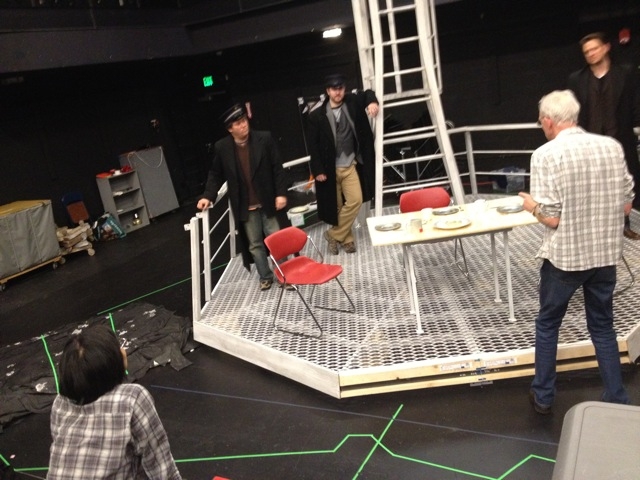
Day 2 of staging The Lighthouse


Assistant Director, Crystal Manich shares some insights into rehearsing an opera. Crystal joins BLO again after working as the Assistant Director for last spring's production of Agrippina. Her interview with Countertenor Anthony Roth Costanzo is here.

David Angus with the three singers of The Lighthouse
The first few days of staging an opera are very exciting: a new group of people has been brought together to create the show ... and no one really knows what to expect. Even though the show plays under 80 minutes, what makes this show particularly challenging is the music. It’s very complicated and intricate. The three gentlemen in this production go over a large section of music with David Angus, our conductor, before putting it onto its feet. This makes for a smoother rehearsal: if the music is fresh, the singers can more easily focus on the staging.

Designer Camellia Koo looks on as Tim Albery leads a staging rehearsal
 Our director Tim Albery creates a really nice atmosphere in the room by providing a clear framework for the piece while also allowing the singers to explore character and movement. It seems that he is also appreciative of his set and costume designer, Camellia Koo, being in the room with us. It’s a rare luxury these days to have a designer be a part of early staging rehearsals. Cami is very helpful when anyone has a question about a costume, a prop or part of the set, and she is able to help make decisions with Tim on the spot as well.

By the end of this week we should be about ¾ of the way through staging the piece. I look forward to seeing where this is going! 

--Crystal Manich, Assistant Director

Monday, January 16, 2012

Building 'The Lighthouse'

This February BLO produces the third annual Opera Annex production; Sir Peter Maxwell Davies' The Lighthouse. In this chamber opera Davies explores the ominous maritime tale of three lighthouse keepers who mysteriously disappeared in 1900 from Northern Scotland’s Orkney Islands. The Opera Annex productions hold a special place my heart because BLO seeks to produce opera in a found space with each Opera Annex. In its first season (2009/2010) BLO brought Britten's The Turn of Screw to the Park Plaza Castle and then in the 2010/2011 Season, BLO transformed the Wimberley Theatre at the Calderwood Pavilion at the BCA into the Emperor's tyrannical world with Ullmann's The Emperor of Atlantis. This season BLO brings the Opera Annex to the John F. Kennedy Presidential Library & Museum

Using a wall of windows overlooking Boston Harbor as the backdrop for the set, designer Camellia Koo created a stunning design--another world of its own. Now, the A.R.T. scene shop is bringing that vision to life. I've had the privilege of observing the set in various stages along the way--beginning with the set model.

Model of the set, created by Koo.
Base of the platform as seen in the set model photo,
in progress at the A.R.T. scene shop.
Crew installs the platform at the rehearsal hall.
As a life-long theatre-geek, I love to see the progression from the designer's vision to finished product. Koo envisioned several pieces to transform Smith Hall at the Kennedy Library  from a hall with a wall of windows to the mysterious world of Davies' The Lighthouse.

Watch a video of the set pieces coming together:

--Karen Robichaud, Design & New Media Manager

Wednesday, November 9, 2011

Opening Night!


Last Friday night marked the opening of the 2011/2012 season at Boston Lyric Opera. I was honored and excited to be a part of the evening, particularly with the opening of Macbeth at the Shubert Theatre. I think the excitement was indeed infectious as everyone dressed up in their best opera-going and party attire for the occasion.

Macbeth is a new production for BLO as well as the commemorative opening of the 35th Anniversary Season for the company; so the evening was much anticipated. I could definitely tell that everyone was anxious to start the show and enjoy the opening night festivities over dessert and champagne afterwards at the Four Seasons in Downtown Boston.

Even though I love running a show, the real pay off comes when the curtain comes down and I talk to those who were in the audience and experienced the music and the action on the stage. It was wonderful to be able to talk to fellow opera lovers who attended the social festivities after the Macbeth opening to hear how each person reacted to the juxtaposition of Verdi’s music and story.

However, the good feedback for a stage manager comes when the audience notices the smooth run of a performance. So, not only did the singer/conductor/orchestra do their jobs well, but the stage management staff complemented their work by making sure that they could give a superb performance without distraction. That’s what makes a successful opera and opening night.

There are only three performances left! I hope to see you at the show!

--Claire

Tuesday, November 8, 2011

BLO Exposed

An intermission conversation series designed to bring you closer to the opera

Join us on November 9 for the first installment featuring BLO Music Director David Angus in conversation with artists from Macbeth live from the stage. No need to go anywhere special—just stay in your seat during intermission and let this insider access come to you. You can even join the conversation on Facebook and Twitter.

To join the conversation:
1) Tweet your questions to @BostLyricOpera using the hashtag #BLOexposed
2) LIKE us on Facebook and post your question there!

We hope you’ll join us during intermission!

Tuesday, November 1, 2011

Flying with 200% concentration


Music Director David Angus, photo by Michael Dwyer
David Angus, BLO’s Music Director, on the final rehearsals for Macbeth

Tonight’s the BIG one, where everything comes together for the first time. 

The thing I love about working on opera is the way it grows and grows. We start preparing at home on our own, then we get together and sing it through with piano, begin to sort out the staging, gradually add props, substitute costumes, bits of pretend scenery, and bring in the chorus. The director and designer know what they want it to look like, and I know what I want it to sound like, but we have to get to know each other and work together for several weeks to make a complete picture where everything coordinates and drives the piece forward in an exciting and intelligible way.

On the side, I prepare the orchestra and then we add the singers, but this week is the exciting week, when we first try things out on the actual stage. Tonight is the “Stage and Orchestra” where all the elements are put together and we see our show complete for the first time, with full costumes, wigs and makeup, and, for me, the most exciting element that has been missing, the lighting. It is an old joke in the business–whenever you see a tatty old bit of scenery or costume, someone always says “just wait until it’s lit”, but it’s true–lighting can transform everything, give instant atmosphere, change night into day, excitement into fear, just at the press of a button.

Darren K. Stokes, Carter Scott & Daniel Sutin
Opera is incredibly expensive to put on with all these different departments working so hard, quite apart from the actual performers–soloists, chorus and orchestra, so rehearsal time with everyone together is extremely limited by cost. Tonight I will have just under 3 hours with everyone to race through the entire opera, stopping to fix anything that is wrong in the music, whilst allowing the staging and lighting to run with minimal interference. It is an intense balancing act. I have to get to the end of the opera, but I have to fix things as well, so every time I am aware of anything wrong I have to make an instant analysis of how serious the problem is, whether it will fix itself next time, or if I really have to stop, explain, go back and do it again. Performances are easy in comparison–I just have to do the show, without any analysis or decision-making.

We started planning this show nearly 2 years ago, and tonight it will all come together for the first time, and we will know if we have a great show, just a good show, or a disaster! From all the elements that we have worked on so far, it has the makings of a great show, with wonderful singing and playing, and a very strong visual presentation. In 2 day’s time, we’ll know for sure, when we have the Dress Rehearsal and add the final element, an audience. But for me, tonight is the really exciting one, when I am flying with 200% concentration in a race against time, but also when we really see our show properly. I can’t wait!

(Rehearsal photo by David Angus)

Monday, October 31, 2011

Notes from Tech Week

While the rest of Boston is out donning their Halloween costumes this weekend, the Macbeth production team and cast are busy in the theatre preparing for our own ghostly and murderous event. There's no time for trick-or-treating when we're knee deep into tech week--as Claire, fellow Assistant Stage Manager explained, the most crucial time to prepare the show and bring all the scenic, prop, costume, lighting, and musical elements together.

We start the day with a lighting session dedicated to bringing the right mood to each scene. We have volunteers called lightwalkers who help us by standing in for the different characters while lights are focused. The lightwalkers are the first outsiders that not only get to look at the set, but get to climb around on it!

The evenings are our busiest rehearsals. Although we work with the crew throughout the morning sorting out details, there is a whole new set of logistics to work out once over 50 singers and actors descend on the scene. As stage managers, we are responsible for answering most of the "when," "where," and "how" questions from the cast. While the director and designers are in the seats of the theatre looking at the big picture, Claire and I are backstage relaying information and organizing the most complex moments of the show so that when the audience arrives, it all runs like clockwork!


--Courtney Rizzo, Assistant Stage Manager

Friday, October 28, 2011

Full Speed Ahead


Macbeth rehearsals are moving to the Shubert Theatre! Everyone is busy at work to assemble all the pieces of the puzzle and create our collaborative Macbeth. This morning, I was at the orchestra read with our Maestro, David Angus and our principal cast. Everyone sounds fantastic and the feeling in the air is nothing but excitement for the week that lies ahead …


Loading set pieces in at
the Shubert Theatre
In the performing arts world, we call this “tech week”. Our schedules are packed with on stage rehearsals under lights, adding all of the production elements together: props, costumes, set pieces, and of course, the orchestra. All of the hard work continues as everyone is working together to produce the finished product in time for opening night. Things can get hectic, but in the end it all pays off. It takes a lot of people working very hard behind the scenes to get everything done.

My partner in crime, Courtney Rizzo (your Stage Right ASM), and I will be working to gather information about the show to pass along to the prop and wardrobe departments in order to help them understand the running of the show and which pieces get added and taken away to tell the story. It’s almost like explaining the action of the opera Macbeth to another group of people who haven’t seen what we have during rehearsals. In short, we lay out the details to everyone.

Check back for updates--we’ll be on stage with Wandelprobe tomorrow evening. Wandelprobe is the German word for when the singers “wander” the stage, marking through their staging motions, and sing with the orchestra playing from the pit.

Until then…
Claire

Saturday, October 22, 2011

Just for fun

We're counting down the hours until we begin our annual Gala, HOCUS POCUS tonight at the beautiful Mandarin Oriental Hotel. Just last night a few of our singers were preparing for an evening of fine food, performance and spooky fun. This little diddy is just one part of the evening's festivities!


(on screen: David Cushing, Nicole Rodin and Michelle Trainor)

Thursday, April 7, 2011

I feel pretty!

The fabulous Nadine Sierra (singing the role of Tytania in Britten's A Midsummer Night's Dream) shares her experience at a photoshoot with Uptempo Magazine:


The entire experience was any woman's dream come true really. To have the opportunity to be photographed in beautiful clothes for a magazine feels incredible, like the movies. It's something we always see in films and wish that could happen in real life. For me, I've never felt like a diva and don't necessarily want to be one. But living a few moments in stunning Christian Louboutin's and sweeping the stage with an erotic Alexander McQueen dress made me feel like an opera diva! I got to play a part in many different designers and even walked with more character as I left the theater. But that's the point of wearing a $2,000 dress sometimes...to feel like your worth every penny and more. Each fold, pattern, color, texture, made me feel like I could express everything I felt in the clothes! And thats the point of fashion, to express something about yourself without the words written all over your body. Instead, there's fabric illustrating your personal tastes on your own skin. It's a fabulous feeling and I truly loved every minute of it.


-- Nadine Sierra


Nadine tries on a dress at her fitting.

Friday, April 1, 2011

BLO's blog got a facelift!

Welcome to Boston Lyric Opera's blog, "In the Wings" - a place for everything you didn't know about opera. And maybe more!


John Conklin, Artistic Advisor to Boston Lyric Opera and general opera aficionado will join us occasionally to share ideas, comments and concepts on the wonderful and beguiling world of opera.


Stay tuned for posts, pictures, and arias.

Tuesday, March 8, 2011

THREE QUESTIONS: Christian Van Horn


Anthony Roth Costanzo takes readers into the world of rehearsing an opera, BLO's upcoming Agrippina.


Our exalted King Claudio in BLO’s production of Agrippina is played by the stellar Christian Van Horn. Christian has appeared in many celebrated opera houses including the Lyric Opera of Chicago Opera (where he is an alumnus of the Lyric Opera Center), San Francisco Opera, Los Angeles Opera, Bayerische Staatsoper, Santa Fe Opera, and the Salzburg Festival. His roles include the title role in Le Nozze di Figaro, Raimondo in Lucia di Lammermoor, Timur in Turandot, Colline in La Bohème, Oroveso in Norma, the Sprecher in Die Zauberflöte, Nourabad in Pearl Fishers, and many others. Not only do we both play the three-name card extremely well, but we also share the same extraordinary managers. To take at look at what they do, visit them at Opus 3 Artists.


ARC

Would you say that there is one thing Handel provides you with as a singer which is distinct from any other composer?

CVH
I would say that Handel really lets you explore a LOT of colors in the voice. The light orchestration allows for a huge dynamic range, rather than just sheer volume. I would say that basses RARELY get to sing pianissimo, and Handel leaves room for that -- especially in the recits.

ARC
You play King Claudio in BLO's Agrippina; is he a good guy or a bad guy and how do you communicate that either vocally or dramatically?
CVH
Claudio is a GREAT guy, even if a bit promiscuous.  As soon as anyone becomes Ceasar his days are immediately numbered. This is not lost on Claudio, and so he is definitely living for the moment. His heart is good, despite his lack of fidelity. After all, Agrippina (his wife) does not exactly make it easy for him to be faithful to her. Vocally, I think Claudio must be very powerful -- at times. He needs to make it clear who the boss in the room is, especially when there are many characters present. Claudio's softer side must also be represented but can really only appear one on one -- with Lesbo, his confidant, or with one of the ladies. 

ARC
In your experience thus far, what's the most fun thing about being a bass-baritone?
CVH
The best part of being a bass-baritone is the characters we get to play. While the tenors and baritones usually get to play the love interest or hero, the basses and bass-baritones generally get to pull the strings and make everyone dance! We often get to play very old men, which presents a fun challenge; and, the "bad guys" are always low voices. Nothing is more fun than playing a bad guy! Also, there are very few operas that don't require a bass-baritone -- which from a practical standpoint is fantastic.   

To read more about Christian, visit his website, www.christianvanhorn.com

Thursday, March 3, 2011

THREE QUESTIONS: Gary Thor Wedow

Anthony Roth Costanzo takes readers into the world of rehearsing an opera, BLO's upcoming Agrippina.

Our brilliant conductor Gary Thor Wedow is unique in his sensitivity, skill, and knowledge of early music. He also has a seemingly bottomless treasure trove of wonderful historical anecdotes that inform the way he crafts opera. Gary went to graduate school here in Boston at the New England Conservatory of Music where he studied with John Moriarty. Later, he was the Associate Conductor of the Handel & Haydn Society. He has conducted an enormous amount of early music: Cavalli, Monteverdi and of course Handel -- no less than 9 Handel operas for New York City Opera, Juilliard, Seattle, and Miami, among others. Next, Gary returns to Seattle to conduct Magic Flute, and then goes to Wolf Trap for Wolff Ferrari's Le Donne Curiose. Gary began our interview with his characteristic exuberance saying that, “It's terrific to come back to Boston where I got a great beginning to a very happy life and I’m so glad to be working with such a dynamite cast in this beautiful and genuinely funny production.”


ARC
Can you explain the fabrication, function, and feeling behind the ornamentation in Boston Lyric Opera's production of Agrippina?

GTW
Ideally the ornamentation comes from the emotional heart of the drama, outlining and embroidering the line both dramatically and melodically.  The character, during the course of the aria goes through an emotional journey and upon the return to the beginning of the aria, their inner life is transformed, so the ornaments reflect the transition or intensification of their emotional life through melody.  There are the 'essential' ornaments: the appoggiatura or leaning note, the messa di voce or spinning out of the note and the trill or warbling, shaking of the voice. Then there are the 'divisions' which divide up one note into many.  Handel's singers (as today's) spent hours training and practicing patterns. As you know, the ornamentation should come from the singer and our beautiful cast has all shaped their own ornamentation.

ARC
We were talking the other day about Handel's life and how it had an impact on his music. Can you speak to the intersection of life and art in Handel's oeuvre as well as in any musician's life?

GTW
Handel for a long time was deified with the virginal morality of the saint. Though he was certainly the composer of heavenly music, his personal life seems very human and emotional. Here is an immensely talented young composer who gets into a quarrel with a fellow composer (Matheson) over who should play the harpsichord in an opera and challenges him to a duel. Later, he becomes the center of a group of wealthy patrons in Italy who were probably gay and where he was known as the Saxon bear; the same circle of intellectual artists surrounded him in London. I feel the evidence points to him being gay and he had a passionate nature and knew well the value of his great gift. I feel an intense responsibility to infuse this music with deep emotion, plugging into primitive and deep wells of primal feelings. Handel felt these emotions first and we recreate and experience these passions ourselves, along with the audience. That's music.

ARC
How do you balance the exigencies of the director, singers, orchestra and administration while trying to craft your take on an opera?

GTW
Bernard Shaw said that opera was an art form which tried to combine five art forms, which is four art forms too many. Everyone feels that their corner of the opera is the most important, and of course they are right because opera needs all of these elements. Music is the heart of opera and if you take good care of your heart, the body is healthy. Opera is all about people; I love people and love working with them, learning from them.  Everyone wants to perform at their optimum, so if you enable people to do their best work, you can fulfill your vision of the opera at the same time.  I'm incredibly grateful and excited to be working on this beautiful opera.

Monday, February 28, 2011

THREE QUESTIONS: Crystal Manich


Anthony Roth Costanzo takes readers into the world of rehearsing an opera, BLO's upcoming Agrippina.

This is the first in a series of posts entitled "Three Questions" where I ask collaborators from the Agrippina team about art, life, and everything in between. My first victim is our production's assistant director Crystal Manich. Crystal, an accomplished director in her own right, just finished helming Handel's Rinaldo for Pittsburgh Opera. She has directed nationally and internationally and received praise from The New York Times and The Wall Street Jouranal, among many other publications, for her extraordinary work. In addition to her engagements as a director and assistant director, she is the co-founder and co-artistic director of Opera Omnia, a company which produces baroque opera. I asked Crystal to elucidate the process of bringing an opera to life:


ARC:
You've just come from directing a Handel opera and will be working on another this summer; while this composer's unique dramatic format is not new to you, does Agrippina represent any firsts, big or small?
CM:
What makes Agrippina unique is the way that Handel writes comedy. The thought that Handel put into deciding whether a text is serious or not is all based on how he sets that text to music.  Musical setting also effects whether a character is telling the truth, lying, flirting, or becoming murderous... the range of possibilities is endless.  Also, as with all Handelian operas, the singer has so much control with regard to the delivery of a line during the recitatives.  One small adjustment, emphasizing a word in one way rather than another, makes all the difference in the world.  Then, of course, one has to consider the physicalization of this text: it's a lot of work!

ARC:
In your experience what role does the atmosphere of rehearsals play in the final product? Can you give us an example?
CM:
Atmosphere in the rehearsal process is essential for the success of a show.  No question.  There is an amazing connection that people build naturally.  Usually it takes less than three days of rehearsal before you feel as if you have known everyone for a long time.  The work is very intimate.  If for some reason there were to be a bad relationship between one person and another, no matter on what side of the stage they work, the performance would be greatly affected.  A positive and nurturing atmosphere guarantees a team effort onstage as well as cohesive storytelling.

ARC:
As a director, do you feel you have a role in changing the face of opera or do you feel there is no change necessary? In creating productions, how can we keep opera alive and relevant?
CM:
I think that opera is just like any kind of live performance: it is always morphing.  That's what good art should do.  When it stops being spontaneous, then it isn't art anymore.  Why would we want to repeat the same staging techniques over and over again?  Puccini (as just one example) wasn't afraid to change the form, so why should we be?  With regard to creating productions, I don't believe in "relevance."  These works survive because there is something universal and true in their stories that is not specific to any time or place.  These are stories about people just like us.  I truly believe that if you present real human relationships onstage--all of the time--then it will always be relevant despite the "style" or time period in which it is set.  It's only when there is dishonesty that it becomes a mere museum piece.  An emperor is a human.  A man who has had his heart broken is no stranger to us.  The greed that is so prominent in Agrippina is recognizable in many aspects of society today.

To read more about Crystal, visit her website: crystalmanich.com