Forward

Friday, March 16, 2012

Facsimile of Rossini's original score

We've certainly had Rossini on the brain recently and our Music Director David Angus was perusing this facsimile of Rossini's original score. Take a look!


Friday, March 9, 2012

ROSSINIANA #26

HAPPY OPENING NIGHT, ROSSINI!

... and so we come to the end of our tour through the wacky world of Rossini ... now check him out LIVE at the Shubert Theatre ... and you'll see on stage a pretty big version of the portrait above as the Grand Maestro himself quizzically looks out over his witty and melodious masterpiece.

 ... and since we've seen and heard a number of manic and crazed versions of Rossini in the past weeks I thought we might end on a quieter note.

Rossini Roundup

Looking for a little reading about Rossini to prepare for tonight's opening of
The Barber of Seville? Check out a couple of articles about Rossini and Beaumarchais,
the dramatist behind The Marriage of Figaro and The Barber of Seville.


Thursday, March 8, 2012

ROSSINIANA #25

I guess it was inevitable ... you really couldn't in the end celebrate Rossini without the inclusion at least one iteration of this (in)famous duet (to say nothing of two). And just to complete the Rossinian game playing it probably isn't by Rossini  after all.


But hold on ... we're almost at the end ... BARBER opens tomorrow.

Wednesday, March 7, 2012

ROSSINIANA #24

A disarmingly crazy and charming Rossini ensemble (from La Cenerentola) strikingly staged by Jean-Pierre Ponnelle. 

Tuesday, March 6, 2012

Announcing the 2012/13 Season!


ROSSINIANA #23

Of course Figaro, the footloose barber, goes on to further life roles ... valet to the Count Almaviva (who has in the mean time married ... and been unfaithful to ... Rosina ...). In the second of Beaumarchais' plays (and Mozart's opera) his suspicions towards his boss and his potentially amorous connections to his bride-to-be Susanna brings out the angry revolutionary in him.


In THE GHOSTS of VERSAILLES (partially based on Beaumarchais' third play LA MERE COUPABLE) Figaro dreams ...


And a few helpful links:

The Ghosts of Versailles
How to Stage a Revolution
Pierre Beaumarchais
La mere coupable

Monday, March 5, 2012

ROSSINIANA #22

Another "Una Voce" ... this one with a true twist. Indeed Joyce DiDonato thought she had only twisted her ankle after a fall during a performance of BARBER at Covent Garden and she gamely finished that evening on crutches. Subsequently, doctors found she had broken her leg. Trouper of the first magnitude she played out the rest of the performances in a cast (pink) ... twisting, twirling in a wheelchair and managing to sing the hell out of the role all at the same time.


For more on the story, check out this interview:


First time Figaro, part 2

So many fun and wonderful things have been happening in our rehearsal process since last I wrote.

One of my favorite parts of the rehearsal process is when we first meet up with orchestra. It was such a thrill for me to meet up with the wonderful orchestra twice this week. It is fun to see David Angus be able to bring different colors out of this tremendous orchestra. During our rehearsals we have had the incomparable Allen Perriello at the piano acting as an orchestra. During our final run of the opera in the Tremont Temple rehearsal space on Tuesday, Allen and I had some fun and played the overture in a Piano Duet/4 hand version.

Wednesday John Tessier, Sarah Coburn and myself were on WGBH in honor of Rossini’s birthday. It was fun to sing excerpts from the opera and do some brief interviews. The broadcast is available on the WGBH website.

Thursday was very thrilling at it was our first day in the theater. This is really an exciting time because we get to finally try out all of our staging on the actual set along with props, costumes, and lights. It is pretty magical and really brings a new energy to the process. The theater is really beautiful and it is fun to see it all come together.

It has been a real pleasure to become close with the cast as we have worked together more and more. Everyone is not only talented but really kind and funny. This has been such a pleasure and we are all looking forward to opening night.

This will be a fun debut for me. When I was a composition major in Boston, I saw my first opera ever. It was Don Giovanni at the Boston Lyric Opera during the 00/01 season and now, a decade later, I get to make my debut at the same opera house in a title role! I feel very blessed.

Sunday, March 4, 2012

ROSSINIANA #21

Not for the first time Rossini lifted a piece of one opera and put it in another (but then again so did another supreme master of the theater--Handel) when he took the Count's last act aria in BARBER and gave it to heroine of his newer work LA CENERENTOLA--where it has  permanently remained. The BARBER version is sometimes performed but is most often cut (as it is in BLO's upcoming BARBER.) In the video below Juan Diego Flores discusses and performs the aria as first written with his usual panache (albeit with, in my opinion, some lingering unease around the edges)


But the real reason to discuss this is to get a performance by Frederica von Stade onto this blog. She is the best ... a lovely flexible voice, impeccable musicianship ... utterly charming, relaxed, funny but always full of the deepest humanity and feeling.

So here is that BARBER aria now as the more famous "Naque all'fanno" from CENERENTOLA.


As for the vision of Rosina in a wheelchair at the beginning of the Flores video check in tomorrow ... all will be explained.


--John Conklin, Artistic Advisor

Saturday, March 3, 2012

ROSSINIANA #20

Gourmet Rossini--a fine slice of echt Italian ham with a side order of tasty pickled herring followed by (and hoping this metaphor doesn't totally collapse under the strain) a nice piece of  NY cheesecake.

Pavarotti


Friday, March 2, 2012

ROSSINIANA #19

I don't know ... I just kind of liked these guys ... they were having fun ...
and they seem to be from Boston ...
 

Thursday, March 1, 2012

ROSSINIANA #18

Some REALLY SERIOUS opera singers (Hotter sang Wagnerian heavies such as Wotan and the Flying Dutchman ... Warren was famous for malevolent operatic villains such as Iago and Scarpia) getting in touch with their inner Rossianian ham. (I think Warren ... here at least ... even looks a little like Rossini).


Wednesday, February 29, 2012

ROSSINIANA #17

HAPPY BIRTHDAY ROSSINI 
... why does the fact that your birthday falls on a Leap Year seem so appropriate and fitting? You are probably the MOST FAMOUS Leap Year guy ever (the only other contenders I could dig up were an odd group--Dinah Shore, Jimmy Dorsey, Michele Morgan, Balthus and the coloratura soprano Reri Grist-- incidentally she sang a mean Rosina in her day). 

Well, here's a special serenade delivered by one of the few remaining descendants of that turkey you so tragically dumped into Lake Como many years ago (for those of you to whom this is  a puzzling reference look back at ROSSINIANA #2). BLO wishes you many happy returns and hopes to see you at the BARBER opening in a few days.

Saturday, February 25, 2012

ROSSINIANA #13


"I know of no more admirable occupation than eating"
                                       Rossini

"Caruso can have his spaghetti with chicken livers, Nellie Melba her toast and peaches. When it comes to Rossini it's all truffles, foie gras and Madeira sauce. Tournedos Rossini, perhaps the most famous of the dishes identified with him, consists of a filet mignon sauteed in butter, then placed on a crouton, also sauteed in butter. This assembly is topped with foie gras and truffles and anointed with a rich Madeira sauce. This recipe was one that Rossini is reputedly said to have suggested to the chef at the Cafe Anglais, the Le Cirque of the Second Empire. The name supposedly came about like this: the maitre d'hotel prepared this dish at tableside but with his back to the other customers so that they would not witness its excesses ... thus the French phrase--"tourner le dos"--became tournedos."
                                        Florence Fabricant (New York Times food editor) 

"We are unwell. It is from eating too much. The Maestro and I live to eat ... I am the fat woman who is occupied from morning to evening in digesting.
                                        Olympe (Rossini's wife writing to a friend)

"Appetite is for the stomach what love is for the heart ... The stomach is the conductor who rules the grand orchestra of our passion ... Eating, loving, singing, and digesting are, in truth, the four acts of the comic opera known as life."
                                         Rossini

Friday, February 24, 2012

ROSSINIANA #12

OK, now it's the LOOK that's a bit bizarre but ... what singing! Rossini in his grandest opera mode (plus a little visit with one of the famous divas).

Thursday, February 23, 2012

Wednesday, February 22, 2012

ROSSINIANA #10

A famously bizarre cartoon by Tex Avery from 1952. After its release, it was sometimes censored--the Chinese and black face bits edited out. But it was also selected in 1993  for preservation in the Library of Congress's National Film registry as being "culturally, historically or aesthetically significant." Apologies for the poor visual quality of this clip ... but you get the idea.

First time Figaro


My name is Jonathan Beyer and I will be singing Figaro, aka “The Barber,” in The Barber of Seville, here at Boston Lyric Opera. I am beyond thrilled to be here. This will be my debut with the company and my debut in this role. Although Figaro’s aria is probably the most famous in the entire repertoire, I haven’t sung any of it until now.

It is a thrilling experience.

I actually am no stranger to Boston. I am from Chicago originally but spent my first two years of college at the Boston Conservatory studying composition and piano. My junior year of college I decided to head back to Chicago and give singing a try. I’m pretty sure I made the right choice. Not only because I've enjoyed success as a singer but because I was a pretty lousy composer! ☺

Performing a role for the first time can be rather daunting. My fellow castmates have already had huge successes in major houses singing these roles. There is a desire to make sure that I keep up with the brilliance and experience they bring to each rehearsal. Each has a fantastic bag of vocal fireworks and hilarious stage gags. Everyone is so fantastic and I am confident that this production will be not only musically astounding but also a laugh riot!

The conductor for our production is Maestro David Angus. He is really spectacular and has such a wonderful feel and energy for the music of Rossini. He has been working with me closely as we determine which ornaments to use for this production. It is tradition to add a great deal of flourishes, additional high notes, and crazy coloratura passages to each piece. We get to start from scratch and pick ornaments that are flashy but tasteful and really represent the drama on stage.

Our director is Doug Varone. He is not only a great director but has a very successful dance company and extensive dance background. He has really been helping us this week create our characters as well as making some fantastic visuals for the audience. It is a very physical and fun production so far! We've finished staging Act 1 … a rather remarkable accomplishment to stage 300 pages in 4 days!

The cast is filled with amazing performers and singers. John Tessier as Count Almaviva has mind blowing high notes and wickedly fast coloratura. As Bartolo, Steven Condy is not only a great singer but an absolutely hilarious actor. His comic antics are matched with the hilarious comic timing of our Berta, Judith Christin. David Cushing has an incredibly impressive sound and Gregory Gerbrandt not only sings a beautiful Fiorello but plays some mean guitar in this show as well.

That leaves us with the Rosina of Sarah Coburn. I have been completely obsessed with her voice since I first heard it when we were singing at Chicago Opera Theater in 2006. I have never experienced such beauty, flexibility, power, and style in a soprano. Her singing is exquisite, she is absolutely gorgeous, charming on stage. Being able to share the stage with this remarkable talent is such an honor.

I cannot wait to perform this show with her!

Monday, February 20, 2012

ROSSINIANA #8

Sir Arthur Sullivan (of Gilbert and Sullivan fame) visited Rossini one morning. When he entered the house, Rossini was feverishly working on a piece of music. Sullivan asked, "Why, what is that?" Rossini answered him most seriously, "It's my dog's birthday and I write a little piece for him each year."

Thursday, February 16, 2012

ROSSINIANA #4

Maria Callas sang Rosina on the stage only once in a run of performances at La Scala in 1956 but her recording made a year later with the feisty Figaro of Titto Gobbi and lovely lyrical Almaviva of Luigi Alva is one of the most persuasive performances of the opera on CD. Her "Una voce poco fa" from a concert in Hamburg reveals Callas's unique take on the role--spicy, mischievous, even a bit dangerous.


An  fascinating historic recording of the famous coloratura Amelita Galli-Curci (made in 1917 ) obviously reveals an entirely different approach but one not without charm and revealing some extraordinary singing technique.


Wednesday, February 15, 2012

Tuesday, February 14, 2012

ROSSINIANA #2


“I love Italian opera- it’s so reckless. Damn Wagner , and his bellowings at Fate and Death. Damn Debussy, and his adverted face I like the Italians like Rossini  who run all on impulse, don’t care a damn about their immortal souls, and don’t worry about the ultimate."
                                             D H Lawrence   (1913)


"I have cried three times in my life: once at the fiasco of the opening night of Barber; the second when I heard  Patti sing for the first time and once when I, while on a picnic cruise, inadvertently  tipped a truffle-stuffed turkey into Lake Como."                                                                               
                                             Rossini


Monday, February 13, 2012

ROSSINIANA #1

Well it's the opening day of rehearsal and we have 26 more days (of intense work by the singers and production staff ) until you have your first chance to see BLO's colorful production of Rossini's masterpiece THE BARBER of SEVILLE. I thought it might be fun to having a running, daily check-in with Rossini's world  here on the blog ... consisting of anecdotes, film clips, various (and wildly varied) performances of his music, etc. I think Rossini  himself, a sardonic self critic, fabled raconteur, and creator of exemplary (even manic) musical wit might well be intrigued or charmed at what we turn up--or perhaps in some cases amusingly  appalled with what has been done in his name. Enjoy.
--John Conklin

----
What better way to kick off than with an Overture:

Friday, February 10, 2012

What's for Dinner on THE LIGHTHOUSE?

If you're on a Scottish lighthouse in 1900, it's a family style plate of oatcakes and pilchards. At least, those are the two items mentioned in the libretto of Peter Maxwell Davies' opera The Lighthouse. As the Assistant Stage Manager in charge of props, food preparation falls into my domain, but I'll admit I did enlist the help of fellow ASM Ginger Castleberry when plating the most pungent of the fish.

We learned from our British director Tim Albery, British conductor, David Angus, and Canadian designer Camillia Koo that oatcakes are a familiar sight in English and Canadian grocery stores, but they were not as easy to find in Boston. A specialty shop in Harvard Square carried some, but finally, our props master ordered the preferred brand online for us to use for the show.

The creative team wanted to stay faithful to the story and have the singers eat real pilchards (canned fish), so we brought a variety of sardines to try. Packed in oil? Too messy. Packed in water? Just as smelly. With mustard? Didn't help the appeal. After a couple rounds of deli meat cut in strips stage management hoped would pass as pilchards, the winner was canned chicken - a little bit flaky like fish and moist enough to be palatable for the singers to eat between lines in the opera.

Wash it all down with water dyed brown to look like tea (most performers don't like to drink caffeine during a show), and you've got a balanced lighthouse meal. Don't forget to save some for the rats!

--Courtney Rizzo, Assistant Stage Manager

Thursday, February 9, 2012

Lighthouses in peril

Thanks to everyone who joined us last night for the opening performance of our third Opera Annex, The Lighthouse. Join us tonight for another stunning performance and prepare yourself with this video of lighthouses in peril. The music is Mozart's Requiem, but perhaps it should be Verdi's Requiem ...


Know of other haunted, perilous lighthouse locations? Share them in the comments.

Wednesday, February 8, 2012

Losing (and gaining the spirit of) two important opera singers

Remarkably, these two important singers died within a day of each other last week and both at the age of 92. Opera history fades so fast and our culture ignores even its recent past, which means it is always good to be reminded, recall (or even learn about for the first time) what our current opera world is built on ... and how so much has changed (opera premiering on Broadway!!) Additionally, we are reminded how much has, unfortunately, stayed the same (the often painful struggle for opportunity, authenticity, and artistic fulfillment.)
Both singers were connected with New York City Opera during the company's better days. Camilla Williams' debut in the role of Madama Butterfly, apart from it's historic ramifications, is fraught with cultural irony. She is also strongly associated with Porgy and Bess which has been much with us this year in a controversial production from A.R.T., now on Broadway in a version that differs from its original operatic aspirations.
"Opera" on Broadway???
Patricia Neway appeared in Menotti there ... as well as winning a Tony for The Sound of Music. 
Operatic voices on Broadway? Microphones ... amplification ... many important questions ... and some answers in the dedication and persistence of these inspiring operatic presences.

--John Conklin, Artistic Advisor

The Ghost of the Lady Light Keeper

Fourth and final in our series of haunted lighthouses:

Location: Gurnet Point/Plymouth Bay
Station Established: 1768
First Lit: 1843
Operational: Yes
Automated: 1986

Near to where the Pilgrims came ashore in the New World, stands one of America's earliest lighthouses, at Gurnet Point in Plymouth, Massachusetts. Originally two towers were built and were first lit in 1769.  John and Hannah Thomas were appointed the keepers of both lighthouses since the towers were constructed on their land.  Shortly after taking the post John left to fight in the Revolutionary War and left Hannah to keep the lights burning all by herself.

John never came back from the war, and in 1790, Hannah was appointed the first female lighthouse keeper in America. In 1801 both towers caught fire and burned to the ground.  The towers were replaced, but the northeast one was dismantled in 1924. Hannah loved the lighthouse and remained as keeper until 1790. Ever since Hannah’s death people have said they have seen her ghost in and around the tower. 

Night at Gurnet Point – Lighthouse Photographers Bob and Sandra Shanklin had the opportunity to stay the night in the keeper’s house on Gurnet Point. 

Told in their own words: At some point, something woke Bob. He raised up on his elbow and watched the light come around, illuminating the windows for a few seconds each time. Then he looked over toward me (Sandra), who was sleeping soundly. Above me, he saw the head and shoulders of a woman. He described her as being a green blue electric spark color. He said she had an old time hairdo, sunken cheeks and the saddest face he ever saw. Bob told me that she wasn't wrinkled and he didn't think she was an old woman. He said he felt no threat from her, but only her sadness. As he watched her, out of the corner of his eye he could see the rays of light from the lighthouse come around several times, brightening the room. He looked toward the light, then looked back to where she had been and she was gone. While there is no way to ascertain with any degree of certainty the identify of the Gurnet Point ghost, Shanklins claimed he had a "feeling" it was Hannah Thomas.

--Kalina Schloneger, Education & Community Programs Intern

-------------------------------------------------------------
Resources/for more about this haunted lighthouse visit:
-------------------------------------------------------------
See our haunting production of Sir Peter Maxwell Davies' The Lighthouse, Feb. 8--12

Tuesday, February 7, 2012

A word about the music of 'The Lighthouse'


BLO Music Director David Angus shares his thoughts about the music of The Lighthouse.

One of the most entertaining things about Sir Peter Maxwell Davies' opera, The Lighthouse, is what he does with the little orchestra. There are only 12 players, but they play more than 30 instruments between them, including some very unusual combinations. At the more serious end, he creates wonderful eerie effects with strange harmonics, flutter-tonguing, glissandi, etc., sometimes extremely quietly, so that the instruments sound totally alien. However, for me the greatest fun comes in the loudest parts, which can be totally deafening! The quieter instruments, such as the violin, viola and guitar, wouldn't be heard at all, so instead he asks the players to play percussion instruments, and they really enjoy themselves!  Our concertmaster, Sandy Kott, smashes the giant Tam-Tam (gong) several times, and the guitarist thumps the big bass drum like a heartbeat throughout the double climax. But for me the best is that our soft-spoken principal Viola, Kenneth Stalberg, is given two flexatones, one in each hand, and he makes as much sound as he can, shaking both of them as hard as possible. (I'm sure there is a viola joke in there somewhere!) He told me that he had been practicing playing the flexatone weeks before the first rehearsal. The final noise at the end comes from the pianist who, as well as attacking the inside of the piano with a drum stick, blows a referee's whistle as loud as he can. It is total chaos!

"Max" has written possibly the most difficult music for orchestra that I have ever come across; each part is like a virtuoso concerto solo. Our players are achieving the impossible, by playing all the notes (and in the right order!) perfectly synchronized with each other, whilst still being flexible enough to follow the singers. Our singers are, if anything, even more impressive, because their music is just as difficult, but they have to do it all by memory, while acting and sometimes even while lying on their backs or climbing up and down ladders. When you add all this to an intelligent and clear staging on a striking set that has been magically lit, you have the recipe for something extraordinary!

Monday, February 6, 2012

The Ghost of a Pirate's Wife

Third in our series of haunted lighthouses:

Location: Sippican Harbor off of Buzzards Bay
Station Established: 1819
First Lit: 1889
Operational: Yes
Automated: 1997
William S. Moore (alleged pirate) took the post as keeper of the Bird Island Lighthouse in 1819 after having fought in the War of 1812. Supposedly he owed the U.S. government money and this position repaid his debt.  He brought with him his wife, who was a heavy tobacco user, and suffered from tuberculosis. Mrs. Moore was forbidden to leave the island by her husband, since he feared she would be unfaithful.

The lighthouse was damp and lonely which worsened Mrs. Moore’s illness and need for tobacco.  The townspeople said they could hear her cries of desperation and would sneak bags of tobacco out to the lighthouse when they could.  One evening Moore raised the distress flag and when the townspeople arrived to help they found Mrs. Moore dead.  Moore insisted that his wife had died from her disease but some townsfolk believed otherwise.  Moore demanded that his wife be buried on the island so she was laid to rest right next to the lighthouse.  Moore was always blamed for the death of his wife and for holding her captive on the island.  Legend has it that keepers have been haunted by Moore’s wife ever since, the ghost of a hunched-over old woman, rapping at the door during the night.

--
Kalina Schloneger, Education & Community Programs Intern
-------------------------------------------------------------
See our haunting production of Sir Peter Maxwell Davies' The Lighthouse, Feb. 8--12

Friday, February 3, 2012

Tech Week for THE LIGHTHOUSE

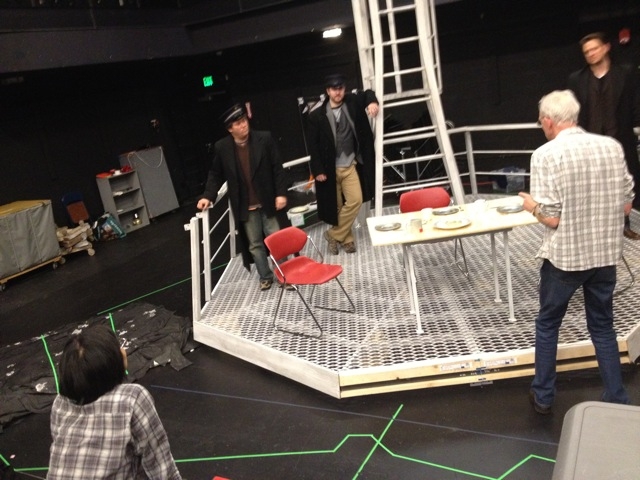
The cast explores the space under the platform,
new to them in the performance space.
Tech week for an opera is always an exciting time: it’s a chance to finally incorporate lighting with full scenic elements and to transform the space where the show will be performed. Our singers for this production of The Lighthouse are, aside from being top-notch singers, great actors who have a lot of flexibility. The transfer from the studio to the stage can be daunting, especially in a show like this where we didn’t have the luxury of having the underside of the main platform available; however, our gentlemen were excited to explore the possibilities available to them by now having the complete set in the real space. The lighting design is one of the most exciting parts of the technical rehearsal process. Our designer, Thomas Hase, has enhanced the story telling that has been created in the staging to portray a menacing, dark world on a remote island. The Kennedy Library has truly transformed into the Flannan Isles …

--Crystal Manich, Assistant Director

Tuesday, January 31, 2012

Week 2 Roundup of 'The Lighthouse' rehearsals


David Cushing and John Bellemer sport their costumes
coupled with their blue jeans in rehearsal.

As The Lighthouse came together quite well during the second week of staging in the rehearsal space, we were able to start seeing the process of the singers turning into their characters as more and more of the real costumes were integrated into rehearsal. For the first week we had rehearsal items of what they will be wearing but, as always, it was helpful to get the real items once the costume shop has completed making them. It was fantastic to see the singers working in their jeans coupled with their actual shirts, vests and jackets. 1900 meets 2012. But even with half a costume, the clothes cause a transformation and make the characters real. This week we also obtained real oatcakes from a specialty UK store in Cambridge, since the opera calls for the men to be eating them: “…it’s tea, and no bread! It’s oatcakes!” exclaims a bitter Blazes. I really enjoyed them, but a few of the other staff in the room didn’t care for their dryness. They are great with tea!

--Crystal Manich, Assistant Director

Monday, January 30, 2012

A Haunted Tower Built on the Sea

Second in our series of haunted lighthouses:


Location:  COHASSET ROCKS
Station Established: 1850
Current Tower First Lit: 1860
Operational: YES
Automated: 1947

Minot's Ledge lighthouse was a place no sane person wanted to live. It is just a tower coming out of the sea on a reef located off Scituate, Massachusetts.  In fact, the first tower was destroyed by the sea only a year after it was completed!  In April of 1851 keeper John Bennet went ashore leaving his two assistants in charge of the lighthouse.  While Mr. Bennet was on land, winds kicked up to more than 100 mph and he could not return to the lighthouse until morning.  When keeper Bennet finally made it back to the lighthouse there was nothing left of the tower.  The bodies of his two assistants washed up later on Nantasket Beach and Gull Island.  Since this tragedy fishermen say they hear cries coming from the island and swear they have seen a man hanging from the ladder screaming to passers by “Stay away! Stay away!”

After the tragedy on Minot’s Ledge other strange things began to happen.  When an assistant was ordered to clean the lighthouse the windows would always be sparkling clean by the time they reached the top to complete the task.  Other keepers heard taps echoing up through the stairs.  This was the signal for the two assistants that they could leave their post. Most keepers learned to live with the ghosts but others lost their minds.  One keeper could not handle it and slit his own throat another went insane and had to be taken from the lighthouse in a straight jacket.

--
Kalina Schloneger, Education & Community Programs Intern

-------------------------------------------------------------
Resources/for more about this haunted lighthouse visit:
-------------------------------------------------------------
See our haunting production of Sir Peter Maxwell Davies' The Lighthouse, Feb. 8--12

Friday, January 27, 2012

General & Artistic Director Esther Nelson on Opera in Boston

As we begin rehearsals for Peter Maxwell Davies’ The Lighthouse, our third Opera Annex production (you really should see the film clip on our website showing the evolution of the set, and also the interview with the composer and our Music Director David Angus), I am experiencing the familiar excitement that comes with turning a production dream into a reality. The tension is even greater with our Annex productions because we are not performing in a familiar theater but in a “found space,” always full of unexpected challenges. Opera is, to me, one of the most exciting art forms, embracing singing, orchestra, acting, set and costumes designs, lighting design, hair and make designs, and much more—it’s really the world’s oldest multi-media art form. Of course, it is costly and we often ask ourselves if we can justify its expense. Is opera still relevant? (more after the jump)

Thursday, January 26, 2012

Strange and spooky origins


The story of The Lighthouse caught the fascination of myself and fellow assistant stage manager, Ginger Castleberry, when we looked up the location of the historical events on which the opera is based, see it on a map: http://g.co/maps/gmzw7

Who knows what really happened on this isolated group of rocks? The real-life Northern Lighthouse Board investigation (the opera's Court of Enquiry) concluded that all three lighthouse keepers were swept out to sea by a powerful wave, but no bodies were ever found washed ashore …

Ginger and I initially theorized the Loch Ness Monster was to blame for the disappearance of the men. After all, Nessie would have been hungry after a 300-mile swim between Loch Ness and the Flannan Isles. However, when we staged the final moments of the opera yesterday, director Tim Albery has provided us a more intriguing—and plausible—interpretation of the final moments of the keepers. The score blurs past and present in a way that gave us clues of how the story could fit together. With only a three person cast, the singers have been delving into the mystery from the perspective of the lighthouse keepers when they were confined together on duty, the relief officers who discovered the empty lighthouse, and impartial narrators after the whole event. You'll have to come and see to be your own judge of the keepers' fate!

--Courtney Rizzo, Assistant Stage Manager

Tuesday, January 24, 2012

Visiting the performance space for 'The Lighthouse'

Late last week The Lighthouse cast and creative team headed out to the Kennedy Library where BLO will produce the piece. We are charged with the exciting challenge to create an opera in a non-traditional space. The room that will be our “stage” at the Library overlooks Boston Harbor and is the perfect location to create a lighthouse. 

The cast of The Lighthouse examine the unfamiliar performances space.
We took the set model with us. In the creation of a new production a set model is built by the designer, in our case Camellia Koo, and enables us to visualize the space as a new and different world. Standing there without the context of the model it would have been difficult to imagine a room used mostly for conferences and public talks converted into a mysterious lighthouse on a remote island located north of Scotland. When we looked at the model and moved around the space to see the placement of each piece, I became excited about the transformation of which we are about to be a part. The view of the bay behind our lighthouse will make the audience feel as if the lighthouse is truly there. This kind of theatrical expression of opera isn’t done as often as it should. That is a pity, for what is more operatic than being in the story yourself?

--Crystal Manich, Assistant Director

Monday, January 23, 2012

Haunted Lighthouses

The lighthouse of Sir Peter Maxwell Davies' opera is not the only lighthouse with a scary and mysterious tale.

Discover the haunted lighthouses near you as we take you on a tour of the haunted lights of Massachusetts. Tales of other haunted lighthouses will appear each Monday until our production of The Lighthouse opens on February 8.
Stop back for all the spooky details.

The Haunting of America's Oldest Lighthouse
Location: LITTLE BREWSTER ISLAND/BOSTON HARBOR
Station Established: 1716
Current Tower First Lit: 1783
Operational: YES
Automated: 1998

The first lighthouse in America was built on Little Brewster Island and was completed in 1716.  Later the original tower was destroyed during the Revolutionary War. The present tower was constructed in 1783 with 14 additional feet added in 1859. The Lighthouse is said to be haunted by its first two keepers, George Worthylake and Robert Saunders. Both gentlemen died within months of accepting their jobs at the lighthouse. After two disasters, some people believed that the island and its lighthouse might be cursed.

The other tale of the old lighthouse on Little Brewster Island is about its very large bell to help warn ships of the dangerous shore line ahead. Despite the size of the bell the ring will not reach a stretch of water several miles east of the lighthouse. The mariners call this area of sea the “Ghost Walk” because ships can not be reached by the guiding sound of the bell. No one has ever been able to explain the Ghost Walk, not even a team of MIT students who spent an entire summer on Little Brewster Island studying the mystery.

--
Kalina Schloneger, Education & Community Programs Intern

 -------------------------------------------------------------
Resources/for more about this haunted lighthouse visit:
-------------------------------------------------------------
See our haunting production of Sir Peter Maxwell Davies' The Lighthouse, Feb. 8--12

Friday, January 20, 2012

Day 2 of staging The Lighthouse


Assistant Director, Crystal Manich shares some insights into rehearsing an opera. Crystal joins BLO again after working as the Assistant Director for last spring's production of Agrippina. Her interview with Countertenor Anthony Roth Costanzo is here.

David Angus with the three singers of The Lighthouse
The first few days of staging an opera are very exciting: a new group of people has been brought together to create the show ... and no one really knows what to expect. Even though the show plays under 80 minutes, what makes this show particularly challenging is the music. It’s very complicated and intricate. The three gentlemen in this production go over a large section of music with David Angus, our conductor, before putting it onto its feet. This makes for a smoother rehearsal: if the music is fresh, the singers can more easily focus on the staging.

Designer Camellia Koo looks on as Tim Albery leads a staging rehearsal
 Our director Tim Albery creates a really nice atmosphere in the room by providing a clear framework for the piece while also allowing the singers to explore character and movement. It seems that he is also appreciative of his set and costume designer, Camellia Koo, being in the room with us. It’s a rare luxury these days to have a designer be a part of early staging rehearsals. Cami is very helpful when anyone has a question about a costume, a prop or part of the set, and she is able to help make decisions with Tim on the spot as well.

By the end of this week we should be about ¾ of the way through staging the piece. I look forward to seeing where this is going! 

--Crystal Manich, Assistant Director

Thursday, January 19, 2012

Program Change: Opera Night at the BPL


Tuesday, January 24, 2012
6:00--7:00pm
Rabb Lecture Hall
Boston Public Library, Copley Square
 
In opera, perhaps the  most dramatic of art forms, the danger, peril and passion are not always exclusively on the stage. Behind the scenes are a multitude of challenges to be met. Join a panel of Boston opera producers, Esther Nelson of Boston Lyric Opera, Aliana de la Guardia of Guerilla Opera, and Sharon Daniels of the Boston University Opera Institute, to discuss what must be overcome and what must go right to bring opera to the stage.


Monday, January 16, 2012

Building 'The Lighthouse'

This February BLO produces the third annual Opera Annex production; Sir Peter Maxwell Davies' The Lighthouse. In this chamber opera Davies explores the ominous maritime tale of three lighthouse keepers who mysteriously disappeared in 1900 from Northern Scotland’s Orkney Islands. The Opera Annex productions hold a special place my heart because BLO seeks to produce opera in a found space with each Opera Annex. In its first season (2009/2010) BLO brought Britten's The Turn of Screw to the Park Plaza Castle and then in the 2010/2011 Season, BLO transformed the Wimberley Theatre at the Calderwood Pavilion at the BCA into the Emperor's tyrannical world with Ullmann's The Emperor of Atlantis. This season BLO brings the Opera Annex to the John F. Kennedy Presidential Library & Museum

Using a wall of windows overlooking Boston Harbor as the backdrop for the set, designer Camellia Koo created a stunning design--another world of its own. Now, the A.R.T. scene shop is bringing that vision to life. I've had the privilege of observing the set in various stages along the way--beginning with the set model.

Model of the set, created by Koo.
Base of the platform as seen in the set model photo,
in progress at the A.R.T. scene shop.
Crew installs the platform at the rehearsal hall.
As a life-long theatre-geek, I love to see the progression from the designer's vision to finished product. Koo envisioned several pieces to transform Smith Hall at the Kennedy Library  from a hall with a wall of windows to the mysterious world of Davies' The Lighthouse.

Watch a video of the set pieces coming together:

--Karen Robichaud, Design & New Media Manager

Wednesday, January 4, 2012

Opera App is more than a Toi! Toi! Toi!

I come from a household of teachers. Both my parents teach and raised me in the classroom. I graded papers (multiple-choice only) and ran ditto copies (yes, kids, that was how people made copies before Xerox). During summer breaks in college I worked as a teaching assistant with special education elementary children. Now, I run a box office which requires me to ‘teach’ on a daily basis – from ‘teaching’ my intern how to sell tickets to ‘teaching’ new subscribers about our production -- I ‘teach’ opera in 2 minute or less.

My wife, a volunteer coordinator for elderly services, works with many student volunteers from BHCC so I jumped at the opportunity to work with these students. The Office of Community Engagement oversees these partnerships.  The office helps students develop tangible skills through community service, civic engagement, and student activism. Through civic-centered or service-centered involvement, the Office of Community Engagement demonstrates to students the connection between community involvement and professional and personal development. What teaches personal development better than a 400 year-old art form associated with the socially elite and performed in a foreign language, right!? This challenge called for a creative lesson plan. (More after the jump)